
A Cafe Built on Twenty Acres and Fifteen Years of Patience
Прочети на български
The baskets hang at eye level on the mezzanine, layered South Asian weavings mounted above the main floor where a Modbar espresso system keeps the bar open between barista and customer. The white walls of Le Mil's Coffee on Polk Street in San Francisco's Lower Nob Hill are deliberate in their restraint. The rattan pendants, the leafy plants, the natural-wood bar with colorful epoxy accents: all designed by married co-owners Milana Ram and Himanshu Bhaisare, both raised in India, both now building something that connects two places across twelve time zones.
The cafe opened on . India's Independence Day. The date was not accidental.
The Farm That Shrank
Ram's great-great-grandfather, Kalasapur Thimmiah, received approximately 200 acres of farmland in Karnataka from the Mysore royal family. Over generations, the land shrank as family members sold their shares. Ram remembers spending time as a child on her grandfather's 60 acres. Today, her parents manage the final 20 acres in Baba Budangiri and Hassan.
Ram chose not to return to India to farm the land herself. She and Bhaisare met at San Francisco State University in 2008, pursuing master's degrees in computer science and electrical engineering. They married. Bhaisare continued in software engineering. And they planned, for fifteen years, to bring Indian coffee to San Francisco.
In 2023, they began roasting. One ton of coffee beans from the family farm. By 2026, they had expanded to source from neighboring farms alongside Navilumane Estate. The cafe followed.
Direct, Transparent, Personal
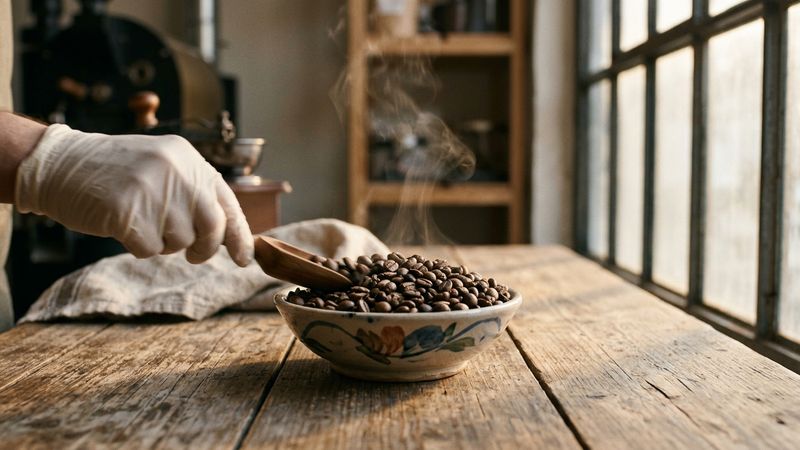
Ram buys the entire crop from her family's farm: organically produced S795, S274, Selection 9, and Cauvery varieties, processed through washed and natural methods. She roasts every two weeks at CoRo, a shared roasting facility in Berkeley.
The neighboring farmer community, according to Ram, is "very proud that a girl from their village has taken their coffee so far and they are excited to work with us." The cafe's success lifts the entire village's coffee profile.
Most specialty roasters source globally, building relationships with farms they visit once a year if at all. Le Mil's operates differently: the supply chain is a family tree. The transparency is not a marketing angle. It is the structure itself.
Bhaisare describes the concept as a "cafe lounge" experience, "bridging the gap between a traditional daytime cafe and an evening lounge, treating specialty coffee with the same reverence as wine." The menu reflects this: South Indian filter coffee, qishr (a traditional Yemeni drink made from coffee cherry husks), manual pourovers, espresso drinks. The food extends to nan khatai, gulab jamun cake, mango-cardamom cake, vegan lassi.
Baristas Who Roast
One detail stands out. As demand grows, Le Mil's baristas participate in roasting sessions. Ram's reasoning: "At Le Mil's, we believe that the baristas should be involved with the bean at a deeper level. Involving them in roasting is our first step toward achieving this."
Most cafes separate roasting from service, treating them as distinct skills.
Le Mil's treats them as continuous. The person pulling your shot has handled the same beans at an earlier stage of their journey.
What the Numbers Say
Fifteen years from first meeting to cafe opening. One ton of coffee in 2023. Twenty acres of a once-200-acre inheritance.
Ram did not return to India to save the farm. She built a market for it instead. The cafe at 1330 Polk Street is not a monument to heritage. It is a working business that carries five generations of agricultural history in every bag of beans.
The neighboring farmers are watching. The baristas are learning to roast. The baskets hang at eye level, woven by hands that understood something about connecting materials across distance.
Frequently Asked Questions
Q: What coffee varieties does Le Mil's serve from the family farm?
A: Le Mil's sources S795, S274, Selection 9, and Cauvery varieties from Navilumane Estate in Karnataka, India. All coffees are organically produced and processed using washed and natural methods before being roasted every two weeks at CoRo in Berkeley.
Q: How long did it take to open Le Mil's Coffee?
A: Milana Ram and Himanshu Bhaisare met in 2008 and planned to bring Indian coffee to San Francisco from that point. They began roasting in 2023 and opened the cafe on August 15, 2026, making it a fifteen-year journey from concept to physical space.
Q: What makes Le Mil's sourcing model different from typical specialty coffee roasters?
A: Le Mil's buys the entire crop from Ram's family farm and now sources from neighboring farms in the same village. This creates a direct, transparent supply chain where the cafe owner has generational ties to the land, rather than the more common model of global sourcing with occasional farm visits.
The Artisan