Cleanliness Is the First Lesson: Nikolay Kostadinov of Better Specialty Coffee

Ask a barista what the most important thing he has learned about coffee is, and you expect to hear about grind, water or temperature. Nikolay Kostadinov answers with a word that appears on no menu and in no recipe: cleanliness.
Better Specialty Coffee is among the participants at Good Coffee Festival in Sofia this September, and Nikolay will be there. The conversation below is part of the Slow Made City series ahead of the festival - ten short questions, not one of them about turnover or locations.
The question that never travels back to the farm
The first question was what he would ask the farmer who grew his beans. What came back was a question about feedback.
"Whether he thinks that once he has sent his beans off, they are handled the way he expects them to be. Whether he is happy with what is done with their work, because in the end they are one of the most important parts of it."
NIKOLAY KOSTADINOV, BETTER SPECIALTY COFFEE
Coffee travels a long way and almost entirely in one direction. The bean leaves the farm, passes through processing and drying beds, sacks, a ship and a warehouse, and reaches the roastery months after the harvest. What travels back is money, and sometimes a single number: the cupping score.
What almost never travels back is the cup. The farmer rarely learns how his lot was roasted, what recipe it was pulled on, or what the person drinking it actually tasted. The traceability the specialty sector is proud of works flawlessly downstream and limps upstream.
A stage for one person, a home for the other
Asked whether a coffee shop is a refuge or a stage, Nikolay split the roles: his own, and the one belonging to the person across the counter.
"For me it is a stage, but I want it to feel like a refuge for the people who come in. Although I would not use the word refuge exactly - I would want it to be a home for our visitors."
NIKOLAY KOSTADINOV, BETTER SPECIALTY COFFEE
The distinction has practical consequences. A stage wants order, tempo and visibility, a bar where every movement can be read from the street. A home wants the opposite: somewhere a person can sit for an hour without being nudged along.
Which is why the next question, about what someone loses by drinking their coffee standing up, produced an answer about people rather than flavour.
"When we are talking about a real specialty coffee shop, you lose what specialty coffee is. You lose the chance to be sociable, whether with the person who made it or with the people around you. You lose the very nature of what specialty coffee is, which is the atmosphere and meeting people."
NIKOLAY KOSTADINOV, BETTER SPECIALTY COFFEE
That is more concrete than it sounds. A specialty bar is one of the few places in a city where a stranger can start talking to you about something you both happen to like without it being awkward. Standing on the pavement, that conversation has nowhere to happen.
Coffee taught him the important part itself
The question of who taught him the most important thing about coffee skipped past every name.
"The most important thing about coffee, coffee itself taught me. I found out how many factors go into making one good, high-quality cup and giving the product the respect it deserves. It is not simply knowing a recipe and executing it well. And one of the most important things, which I also did not know, is hygiene at the workstation, whether at home or in a shop."
NIKOLAY KOSTADINOV, BETTER SPECIALTY COFFEE
Cleanliness behind a bar is not decoration, it is taste. Coffee oils go rancid: grounds sit in the grinder chute, in the mesh of the basket and around the group screen, and by the next day they no longer smell of coffee. An uncleaned doser puts yesterday into every shot that follows, and the person pulling those shots stopped noticing long ago, because he has grown used to it.
The steam wand works the same way. Milk dries onto it within seconds, and after the third cappuccino there is a layer inside that has nowhere to go except into the fourth. Which is why in a well-run bar the steam cloth is its own cloth, and the groups are backflushed on a schedule rather than whenever there is a gap.
The cups that never leave the bar
Asked whether he had ever been ashamed of a cup he served, he turned the question around.
"No, but I have been ashamed of plenty of cups I did not serve. I have never served a cup I was not fine with serving. That is how I train the people who work with me: if you do not like something and you would not drink it yourself, we do not serve it to people."
NIKOLAY KOSTADINOV, BETTER SPECIALTY COFFEE
The rule sounds obvious and is broken almost everywhere at peak hour.
A dumped cup costs coffee, milk and two minutes, and there are six people waiting. That is precisely where it is decided whether a place has a standard or only a price list.
The harder half is the second one. The person who has been behind the bar for three weeks needs the same permission. If he is afraid to pour something away, the standard belongs to one man rather than to the place, and it leaves with him on his day off.

Explaining it is the harder half
Asked which is harder, making good coffee or explaining it, the answer was short.
"Explaining it in a way that people actually understand you is probably the harder one."
NIKOLAY KOSTADINOV, BETTER SPECIALTY COFFEE
The trouble is the vocabulary. To most people "acidity" sounds like a fault rather than a quality, "fruity" reads as flavoured, and "light roast" is heard as weak. The language the sector uses for the best thing in the cup pushes away exactly the person it was invented for.
So the explanation that works across a counter is rarely technical. What works is a comparison to something the person has already eaten, and the question of what they normally drink, asked before the cup is made rather than after.
The motto on the wall and the one underneath
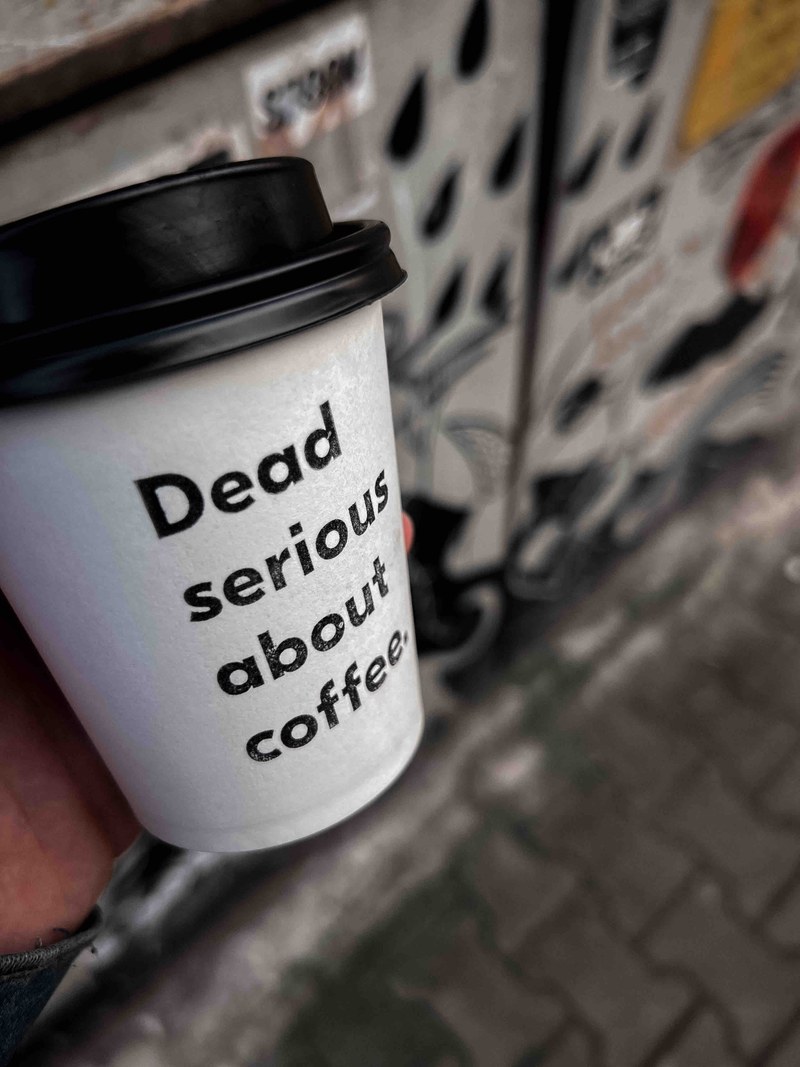
If the shop had a motto carved above its door, it is already there. It is printed on every takeaway cup.
"The one we have now: Dead Serious About Coffee. Or the hidden one, which is where the name Better comes from: that from day one we try to make every next cup for our customers a better one."
NIKOLAY KOSTADINOV, BETTER SPECIALTY COFFEE
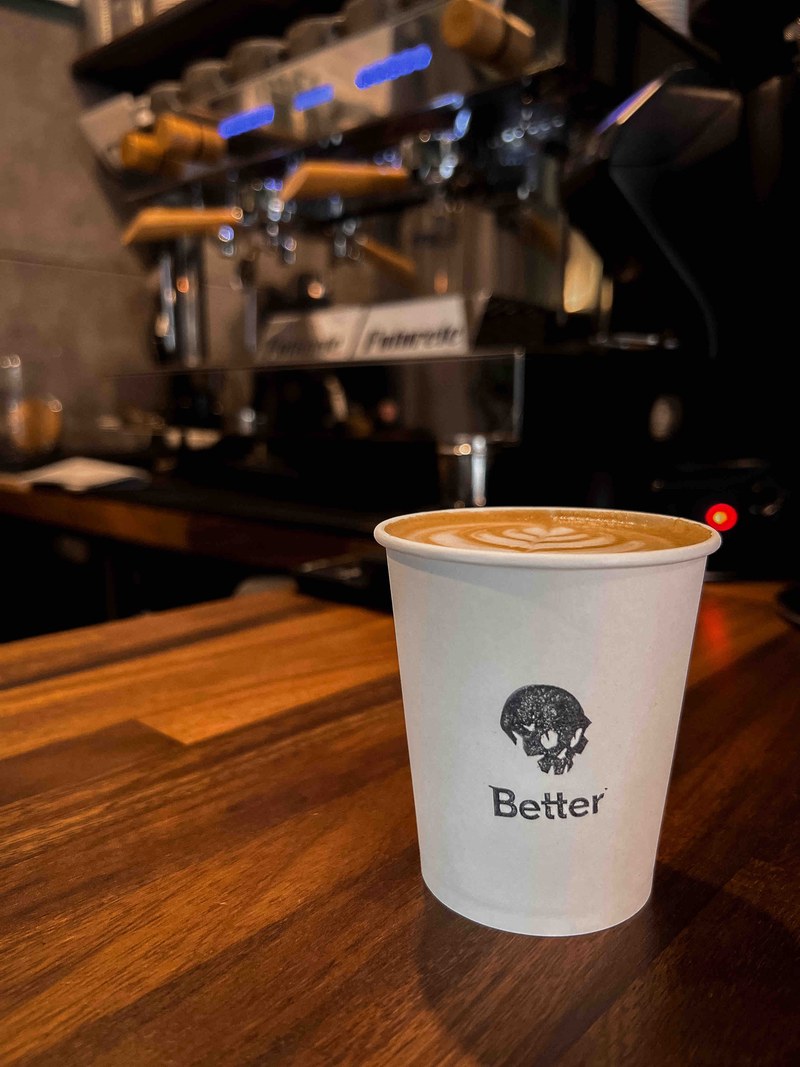
The first motto is a joke kept in proportion. The skull on the cup and the skeletons on the window make the seriousness bearable without cancelling it. The second is written nowhere and explains the name. "Better" is not a state but a comparative, and always against the previous cup rather than against the shop next door.
That promise is uncomfortable precisely because it has no finish line. A place that claims to be good can prove it once. A place called better owes the proof every morning.
The last question was whether there is a customer he worries about when they fail to appear. "Absolutely not. If they do not show up, they are on holiday," Nikolay said, laughing. And if coffee vanished from the world tomorrow, he had said earlier, he would probably move to cacao. At a festival where specialty coffee and craft chocolate get together, that reads less like a joke than like a plan.
At the counter in September, order and stay on your feet as long as you like, but ask the question most people do not: what is this, and why is it like this. Explaining is the harder half of the job, and the only half that also depends on you.
Frequently Asked Questions
Q: Why does cleanliness behind the bar change how coffee tastes?
A: Coffee oils go rancid. Grounds sit in the grinder chute, in the mesh of the basket and around the group screen, and by the next day they no longer smell of coffee, yet they go into every shot that follows. Milk dries onto the steam wand within seconds, so after the third cappuccino the layer inside ends up in the fourth. That is why Nikolay Kostadinov of Better Specialty Coffee names hygiene at the workstation as the most important thing coffee taught him.
Q: What do you lose by drinking your coffee standing up rather than sitting down?
A: In Nikolay Kostadinov's answer you lose exactly what specialty coffee is: the chance to be sociable, whether with the person who made the cup or with the people around you. What goes is the atmosphere and meeting people, not only the flavour that suffers when a drink is sipped through a lid.
Q: Where does the name Better Specialty Coffee come from?
A: From the promise that every next cup will be better than the last one. That is the shop's hidden motto. The visible one is printed on its takeaway cups and reads "Dead Serious About Coffee".
Q: When is Good Coffee Festival 2026, and is Better Specialty Coffee taking part?
A: Good Coffee Festival runs from 11 to 13 September 2026 in front of the National Palace of Culture in Sofia, and gathers more than 70 participants: roasters, coffee spaces and baristas. Better Specialty Coffee is among them, and Nikolay Kostadinov will be there.
The Barista