
Rain Falls the Same Everywhere. Why Does the Water Taste Different?

If you have ever brewed the same coffee in two different kitchens and noticed the cup tasted different, you have already encountered the question this article answers. The beans were identical. The grind was the same. The water was not.
Water is not a neutral carrier. It is a record of the landscape it passed through, and understanding that record is the only way to understand why the same rain produces different water in different places.
Precipitation as a Starting Point
Rain and snow arrive at a mountain with almost no mineral content. According to research on mountain spring water, precipitation falls essentially mineral-free. Everything you taste later was dissolved underground. How a mountain turns rain into that is one of the subjects of “The First Ingredient”, the season in which Slow Made City writes about water together with Devin.
The moment water soaks into the ground, its transformation begins. Some runs off into streams. Some evaporates. And some disappears into the earth, beginning a slow descent through soil, clay, and rock that can last years or decades. Two raindrops falling on the same mountain, a few hundred metres apart, can end up as completely different waters depending on which path they take underground.
Rock as Filter and Record
Underground, water encounters two types of rock. Permeable rock, like fractured limestone, lets water pass through. Impermeable rock, like dense clay or unfractured granite, stops it. The interplay between these two determines where water collects, how long it stays, and what it becomes.
As water moves through permeable rock, it dissolves minerals. This is not contamination. It is inscription. The U.S. Geological Survey describes how weak carbonic acid, formed when rainwater percolates through organic matter in soil, enters rock fractures and slowly dissolves bedrock. The process can take tens to hundreds of thousands of years.
Different rock compositions create different mineral signatures. Limestone contributes calcium and bicarbonate. Dolomite adds magnesium. Granite and basalt, being harder, give up almost nothing. The water that emerges from each carries a distinct chemical fingerprint.
The Rhodope Mountains are one of Bulgaria's oldest and most geologically complex ranges. According to geological surveys, the Rhodopes are a rugged terrain of Precambrian crystalline rocks, a fragment of a once much larger crustal block. Water that passes through such ancient formations carries a mineral signature shaped by deep time.
The Catchment as a Piece of Land
A catchment is the landscape that feeds a spring, the bounded area from which rain drains toward a single point of emergence. What happens on that land matters. A catchment covered in forest filters water differently than one with exposed rock. A catchment protected from agriculture produces water with a different profile than one where human activity has altered the soil chemistry.
This is why some springs are protected and some are not.
The catchment is not just geography. It is the first chapter of the water's story.
Time Underground as a Variable
Water does not move quickly through rock. It spends years, sometimes decades, in contact with the geology around it. Hydrogeological research on volcanic aquifers shows that deeper groundwater has a different chemical character from shallow groundwater, precisely because of this extended contact time.
This is why spring water and mineral water are not the same thing. The distinction is not marketing. It is a matter of how long the water was in contact with rock and how much it dissolved along the way. Water is not instantaneous. It is aged.
Why This Matters in a Cup
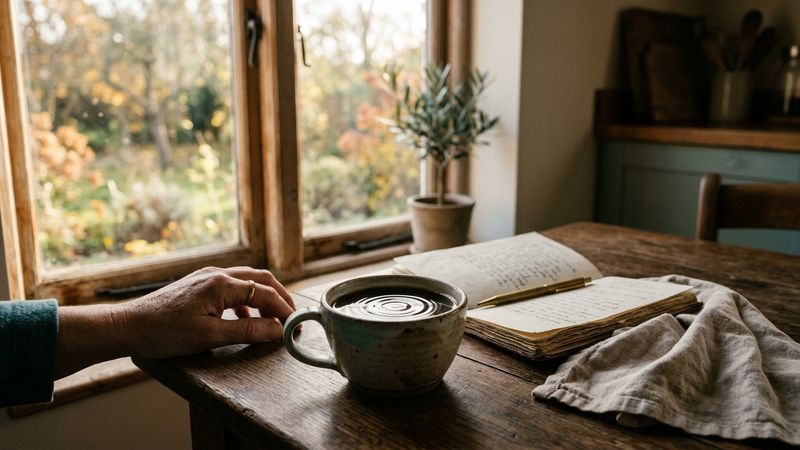
Coffee is more than ninety percent water. The minerals dissolved in that water, particularly calcium and magnesium, directly influence how flavour compounds extract from ground coffee. According to research on water chemistry and coffee, too few minerals can result in under-extraction, where coffee tastes weak and flat. Too many minerals can lead to over-extraction, producing harsh, bitter flavours.
This is why the same coffee tastes different in different kitchens. The beans are a constant. The water is a variable, and that variable was written by geology long before it reached your kettle.
A Glass of Water as a Journey
A glass of spring water or a bottle of mineral water is not simply H₂O. It is a record of precipitation that fell months or years ago, filtered through soil and rock, shaped by the geology of a specific place, and aged underground before emerging into daylight.
The same rain falling on different rock produces different water. Understanding this changes how you think about a glass of water, and about the cup of coffee you brew with it.
Frequently Asked Questions
Q: What determines the mineral content of spring water?
A: The mineral content is determined by the type of rock the water passes through and how long it remains in contact with that rock. Limestone contributes calcium and bicarbonate, dolomite adds magnesium, and gypsum introduces sulfate. Water that spends decades underground dissolves more minerals than water that moves quickly through permeable rock.
Q: How does water mineral content affect coffee brewing?
A: Minerals like calcium and magnesium help extract flavour compounds from coffee grounds. Water with too few minerals leads to under-extraction, producing weak, flat coffee. Water with too many minerals causes over-extraction, resulting in harsh, bitter flavours.
Q: What is the difference between spring water and mineral water?
A: The distinction relates to contact time with rock, and to law: in the EU, natural mineral water and spring water are separate legal categories, and natural mineral water is defined by a characteristic, stable composition from its source. Spring water may have lower mineral content depending on how quickly it moved through the ground and what type of rock it encountered.
The Artisan