
The Art of the Unhurried Walk: What You Notice When You Stop Optimising

A crack runs through the plaster on ul. Tsar Shishman, just past the corner where the street bends toward Oborishte. It has been there for years, probably decades, shaped like a river delta if you look at it long enough. Most people do not look at it at all. They are walking somewhere.
This is not a complaint about modern life or a call to slow down for its own sake. It is an observation about what gets filtered out when every walk has a destination and a timeline. The crack in the plaster is information. So is the way the light hits the courtyard behind the green gate at 4pm in September, or the sound of someone practising piano through an open window on ul. Shipka, or the fact that the same bench near Aleksandar Batenberg Square is occupied by different people at different hours, each with their own rhythm.
Sofia rewards this kind of attention, though it rarely demands it. The city's layout is a mix of planned boulevards and organic growth, passages that lead somewhere unexpected, courtyards that open behind unremarkable facades. But the pressure to optimise time, to treat walking as transit rather than presence, means most of this goes unseen. The neighbourhoods being rediscovered, Lozenets, Oborishte, Knyazhevo, are often consumed rather than inhabited. People arrive, photograph, leave. The texture stays behind.
What Gets Filtered Out
The optimised walk skips the micro-details. It skips the seasonal shifts: how the Women's Bazaar changes through the day, quieter in the early morning, louder by noon, different vendors at different hours. It skips the social textures of a street, the way a corner reveals different people depending on when you pass it.
These are not beautiful details in the Instagram sense. They are information about how a place actually works, who uses it, when, and why.
A street market is not a static thing. It has a rhythm. The same is true of a courtyard, a square, a passage. But rhythm requires time to perceive. When you are navigating, getting from point A to point B, you are not exploring. You are not being somewhere. You are passing through.
The Cognitive Shift
There is a difference between navigation and exploration. Navigation is goal-directed: you know where you are going, and everything between here and there is obstacle or shortcut. Exploration is open-ended: you are not going somewhere, you are being somewhere. The perceptual shift is real. When you remove the goal from a walk, you start noticing things that were always there but never registered.
Sofia's street layout almost demands this kind of reading. The passages near the Women's Bazaar, the courtyards of Oborishte, the unexpected turns in Knyazhevo, these are not designed for efficiency. They are designed for discovery, or at least they were built in a way that makes discovery possible. But discovery requires a different mode of attention than transit.
The Practice
The risk is that unhurried walking becomes another optimisation: a mindfulness exercise, a step-counting goal, a wellness practice with metrics.
That defeats the point. The practice is simpler. Pick a neighbourhood. Remove the timeline. Walk without destination.
Aleksandar Batenberg Square is one place that rewards this. So are the passages near the Women's Bazaar, where the same street looks different depending on the hour. The courtyards of Oborishte, if you can find the open gates, reveal a different city behind the facades. These are not hidden gems. They are ordinary places that reveal themselves differently when you are not optimising.
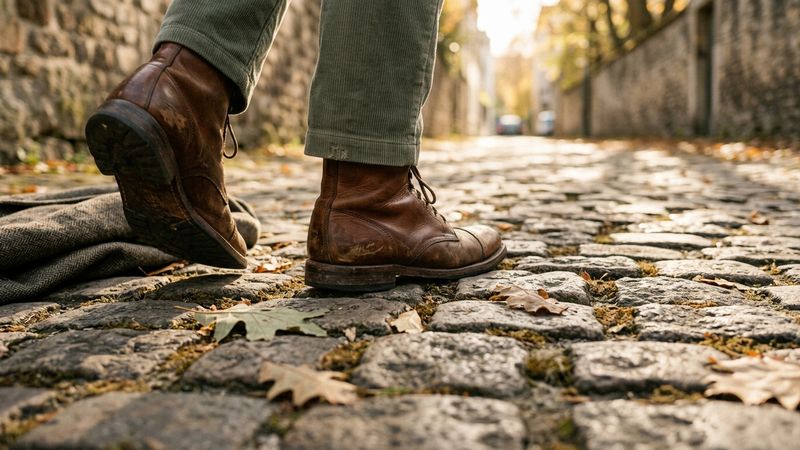
This is not accessible to everyone equally. Time, safety, mobility, and circumstance shape who can walk and how. The unhurried walk is not a universal prescription. It is a practice available to some, under some conditions, and worth naming for those who can try it.
Inhabiting, Not Escaping
The point is not to escape the city. The point is to inhabit it more fully. The unhurried walk is a form of citizenship, a way of knowing a place that cannot be replaced by maps or guides or recommendations. It is not about finding something beautiful. It is about recovering a way of seeing that productivity culture has trained you to skip over.
One walk. No destination. No timeline. Notice what you notice. The crack in the plaster is still there, shaped like a river delta, waiting for someone to look at it long enough.
Frequently Asked Questions
Q: What is the difference between an unhurried walk and a mindfulness walk?
A: An unhurried walk has no goal, including no wellness goal. Mindfulness walks often come with instructions, breathing patterns, or step-counting. The unhurried walk is simply walking without destination or timeline, letting attention settle on whatever is there.
Q: Which Sofia neighbourhoods are best for unhurried walking?
A: Oborishte, Lozenets, and Knyazhevo all have street layouts that reward slow attention, with courtyards, passages, and unexpected turns. The area near the Women's Bazaar changes character throughout the day and offers different textures at different hours.
Q: How long should an unhurried walk last?
A: There is no prescribed length. The practice is defined by removing the timeline, not by hitting a duration target. Some walks last twenty minutes, some last two hours. The point is that you are not measuring.
The Flaneur