
The Code on the Label: What Tasting Notes Actually Mean

A bag of coffee sits on the counter. The label reads: boysenberry, cocoa, jasmine. Three words that sound like a dessert menu, not a description of roasted seeds.
Did someone add boysenberry to this coffee? Is there jasmine extract somewhere in the blend? No. Nothing was added. Those words describe something already present in the bean, waiting to be recognized by anyone who knows how to listen.
Tasting notes on specialty coffee labels look like ingredient lists because that is how most food packaging works. But coffee operates by different rules. The vocabulary on that label is a shared language, developed over decades by sensory scientists, designed to communicate what a trained palate can detect in a specific lot.
Where the Words Come From
The vocabulary of coffee tasting was built through systematic sensory research, most notably through the collaboration between the Specialty Coffee Association (SCA) and World Coffee Research (WCR), which produced the Coffee Taster's Flavor Wheel in 2016.
The wheel is anchored to the WCR Sensory Lexicon, a catalog of 110 flavor and aroma attributes, each defined with a specific physical reference standard. "Jasmine" is not a vague impression. According to research on the flavor wheel's scientific foundation, the reference is a jasmine tea bag steeped at 3 grams per 100 ml. "Butter" is Land O'Lakes butter at room temperature. These standards ensure that professionals in Sofia, Nairobi, and São Paulo calibrate to the same perceptual benchmarks.
The reason these words work is chemistry. A coffee cherry contains hundreds of volatile compounds, and some are chemically identical to compounds found in berries, flowers, or chocolate. When a label says "boysenberry," the coffee contains aromatic molecules that also appear in boysenberries. The word is not a metaphor. It is an accurate description of shared chemistry.
What the Words Promise
A tasting note is a direction, not a guarantee.
"Cocoa" on a label means: in this lot, under these conditions, a trained palate will recognize aromatic compounds that also appear in cocoa. It does not promise the coffee tastes like hot chocolate. It is a map for the nose and palate.
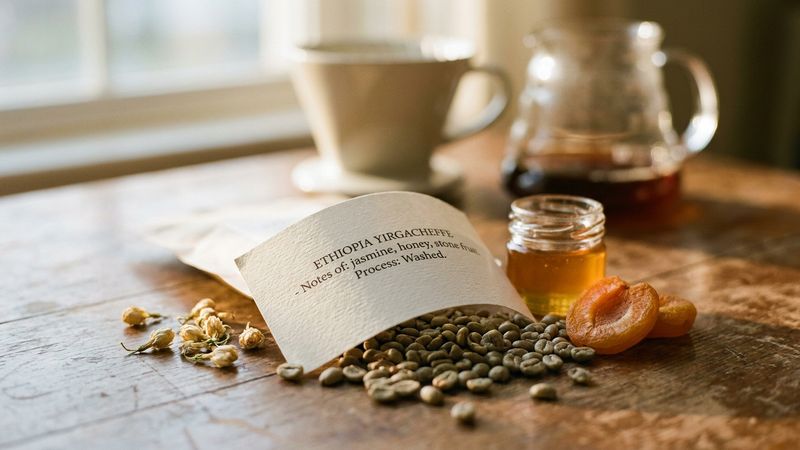
The same variety, grown at different altitudes or processed differently, will produce different tasting notes. A washed Ethiopian Yirgacheffe might read "bergamot, black tea, lemon." A natural-processed lot from the same region might read "blueberry, wine, dark chocolate." The processing method changes which volatile compounds develop during fermentation and drying.
The Most Misread Word
Acidity is the term that trips up most readers.
It does not mean sour. It does not mean the coffee will upset the stomach.
In coffee vocabulary, acidity describes brightness, complexity, liveliness. A coffee with high acidity feels vibrant on the palate, often with citrus or stone-fruit character. A coffee with low acidity feels rounder, heavier, sometimes described as "smooth." Many of the most prized single-origin coffees, particularly from East Africa and Central America, are celebrated precisely for their acidity. A label that reads "bright acidity, citrus, floral" describes a coffee that will feel lively and complex, not one that will taste like vinegar.
Reading the Label as a Map
Every tasting note results from a chain of decisions. The variety planted. The altitude of the farm. The processing method: washed, natural, honey, or experimental techniques like anaerobic fermentation. The roast profile. Each variable shapes which volatile compounds survive into the cup.
A label that reads "washed, 1,800 meters, SL28 variety, blackcurrant, grapefruit, black tea" is evidence that someone has paid attention to what happened to this coffee, from farm to cup. A roaster who can name the farm, the harvest date, and the processing method can also explain why the coffee tastes the way it does. The vocabulary becomes a form of transparency.
The next time a label reads "boysenberry, cocoa, jasmine," the words are not asking for belief. They are asking for attention. Smell the grounds before brewing. Taste the coffee as it cools, because different compounds become perceptible at different temperatures. The jasmine might appear in the aroma. The cocoa might emerge in the finish. The boysenberry might be a fleeting impression at the back of the palate, gone before it can be named.
This is not pretension. It is literacy.
Frequently Asked Questions
Q: Are tasting notes like "blueberry" or "jasmine" added flavors?
A: No. Tasting notes describe naturally occurring volatile compounds in the coffee bean that are chemically similar to compounds found in those foods. Nothing is added. The words describe what a trained palate can detect in the coffee's natural aroma and flavor profile.
Q: What does "acidity" mean on a coffee label?
A: In coffee terminology, acidity refers to brightness and liveliness on the palate, not sourness or stomach upset. High-acidity coffees often have citrus or stone-fruit character. Low-acidity coffees feel rounder and smoother.
Q: How were the standard tasting vocabulary terms developed?
A: The current Coffee Taster's Flavor Wheel was developed in 2016 through collaboration between the Specialty Coffee Association and World Coffee Research. It defines 110 flavor and aroma attributes, each paired with a specific physical reference standard to ensure consistency across the global coffee industry.
The Barista