
The Glassblowers Behind Your Chemex
Прочети на български
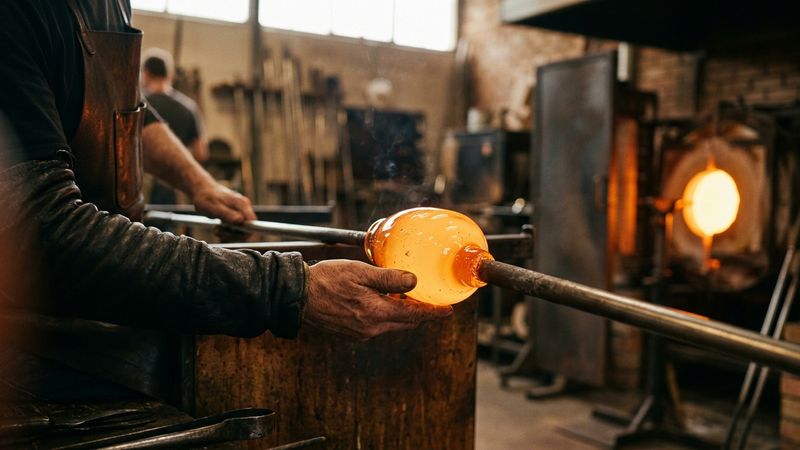
Louisa Raven learned to blow glass, earned her MA from the Royal College of Art, and then spent twenty years away from it. Three years ago she came back to this. The furnace runs at 2,400 degrees Fahrenheit, around the clock, every day. At that temperature, glass becomes a glowing orange liquid that moves like honey and forgives nothing. The moment the blowpipe goes into the molten mass, rotation begins and cannot stop. Hesitate, and the glass falls back into the furnace. Blow too hard, and the bubble bursts. Blow too softly, and nothing happens at all.
This is how coffee equipment has been made for centuries. The Chemex carafe sitting on your counter, the decanter at your favourite specialty café, the stemmed glass someone handed you at a tasting: each one began as a blob of liquid silica, shaped by breath and gravity and a set of tools that have remained essentially unchanged since an unknown craftsperson in Syria discovered the bubble effect over 2,000 years ago.
The Technique That Refuses to Modernise
According to Nicholas de Godoy Lopes, curatorial assistant at the Corning Museum of Glass in New York, "very few of the basic techniques developed by glassblowers have 'left.' Some may get less attention or have a far smaller base of practitioners than they once had, but very few have been truly forgotten." What he describes is a craft that has resisted automation not because artisans are stubborn, but because the physics of molten glass demand human judgment at every step.
The process involves three furnaces. The first, running 24/7 at 2,400-2,600°F, holds the molten glass. After gathering glass on the blowpipe, the glassblower rolls it on a thick steel sheet to cool the exterior, a step called marvering. Then comes shaping, blowing, and reheating in a second furnace called the glory hole. Finally, the finished piece enters an annealer, a third furnace that slowly cools the glass over hours to prevent cracking.
Every handle, every stem, every pour spout requires a separate attachment, each one reheated and joined while the glass is still workable. Rush any step, and the piece shatters.
When Manufacturing Changed Everything
The 1820s invention of pressed glass, where molten glass is pressed into moulds rather than blown, transformed the industry. Suddenly, glassware became cheap and uniform. The drinkware at most cafés today is machine-blown into moulds, each piece identical to the last.
This is not a criticism. Mass production made glass accessible. But it also made handblown glass rare, and rarity changes how we see things.
Raven works out of London. The appeal, for her, is not only in what comes out of the furnace.
"I like the vague danger and excitement of it all. It's quite a performance. I love the fact that the tools and techniques haven't changed for hundreds of years."
Louisa Raven
Her philosophy is practical: "Using something handmade should be one of life's daily rituals." Not locked in a cabinet. Not saved for guests. Used.
The Coffee Connection
Chemex, the hourglass-shaped brewer designed in 1941, has maintained a handblown line since its founding.
Those pieces are produced in small lots in Croatia, shaped by skilled glassblowers using the same techniques that Murano artisans protected with death-penalty secrecy for 500 years.
In Massachusetts, Lucas Land uses a different approach: flameworking on borosilicate glass at 4,000-5,000°F. His silver-fuming technique vaporises 99% pure silver onto the glass surface, creating drinkware that changes colour depending on what you pour into it. Tea brings out pinks and purples. Black coffee produces a deep blue.
"It's a piece that, when you're sipping your coffee in the morning, you end up holding onto it the entire time because it just fits in your hands so right."
Lucas Land
Sofia's Glass Comes From Somewhere Else
Bulgaria has a long tradition of craft production, from pottery to woodworking to textile arts. Glassblowing, however, remains largely invisible in Sofia's growing specialty coffee scene. No local studio produces handblown coffee equipment at scale. No café prominently features Bulgarian-made glass decanters.
The conditions for a revival are not exotic. Bean-to-bar chocolate makers emerged in Sofia over the past decade on the strength of a growing appreciation for process, a willingness to pay for quality, and a community of curious consumers - the same combination glassblowing would run on.
Two thousand years did not make the craft safe. What carries it forward is not the age of the technique but the people who still choose to learn one that machines had already made optional. That is what is at stake in a handblown carafe on a counter - not a nostalgia purchase, but a skill that lasts exactly as long as someone keeps practising it.
Frequently Asked Questions
Q: What makes handblown glass different from regular glassware?
A: Handblown glass is shaped by breath and gravity rather than pressed into moulds, making each piece unique. The process requires three separate furnaces and cannot be rushed without risking breakage.
Q: Why is handblown coffee equipment more expensive?
A: A single piece requires constant rotation, multiple reheating cycles, and separate attachments for handles or stems. The furnace runs 24/7 at 2,400-2,600°F, and the techniques demand years of training.
Q: Does Bulgaria have any glassblowing studios producing coffee equipment?
A: Currently, no Bulgarian studio produces handblown coffee equipment at scale. The craft exists here in limited forms, but specialty coffee glassware remains an untapped opportunity for local artisans.
The Artisan