The Hands That Refuse to Hurry
Прочети на български
A kinetic disc spins slowly in a Palladian cloister, catching light and throwing it across stone walls that have stood for five centuries. Nearby, a structure resembling a moon rises from a swimming pool. These are not the fever dreams of a Venice Biennale installation artist with unlimited budget. They are the centrepieces of Homo Faber 2026, the biennial craft exhibition running until 30 September on San Giorgio Maggiore island, and they exist to make a point about what human hands can still do.
Where Sofia Meets San Giorgio
This year's edition, titled An Island of Light and directed by British designer Es Devlin, brings together more than 500 artisans from 70 countries. Among them are makers from Bulgaria and the broader Balkan region, their ceramics and textiles displayed alongside work from Japan, Lebanon, and Denmark. For a Bulgarian artisan to stand in that company is evidence that the craft traditions of this region, often dismissed as folk curiosity, can hold their own in the global conversation about what handmade means now.
In Sofia, the same ethos animates the city's growing specialty coffee scene. At Blue Bag Specialty Coffee, the approach to sourcing and roasting mirrors the philosophy on display in Venice: verified farms, peak-ripeness beans, small batches that cannot be rushed. Like a ceramicist or glassblower, a specialty coffee roaster cannot automate away the human judgment required to transform raw material into something singular.
The Shadow Behind the Objects
At Casa Sanlorenzo, another Homo Faber venue, an exhibition from Luxembourg called Fiat Lux carries a curatorial statement worth reading twice:
In the face of automation and seemingly limitless reproducibility, the pieces assert themselves through their singularity, their irregularities, and the slowness with which they were conceived and crafted.
This is not romantic posturing. Craftspeople today compete with AI-generated designs, cheap copies that undercut original work, and an economic system that struggles to value time spent making things by hand.
The world is running at 500 kilometres an hour. People are tired of this frenetic life.
Alessandro Boscolo, Murano glassblower
Why Craft Is Having Its Moment
Forecasting agencies predict strong growth for the arts and crafts market over the next few years. The design and fashion worlds have become obsessed with the word craft, though not all of that obsession is genuine.
But the deeper reason for craft's resurgence is harder to fake.
Tangibility matters. The knowledge that a real person, with a real story, made the object in your hands cannot be replicated by an algorithm. The 700 artisan pieces on display at Homo Faber carry that knowledge in their surfaces.
The exhibition's first room, A Language of Hands, recreates atelier workstations with sketches on the walls and creative mess spread across tables. In other spaces, artisans sit at their desks demonstrating their crafts, from metal hammering to reed weaving. The presence of the makers themselves is the point.
What Remains When the Algorithm Stops
Es Devlin's artistic direction creates an immersive experience with poetic voiceovers and mood-setting music. The kinetic disc called A Great Turning reflects light around the cloister in patterns that shift with the hour. The effect is theatrical, but the substance is not.
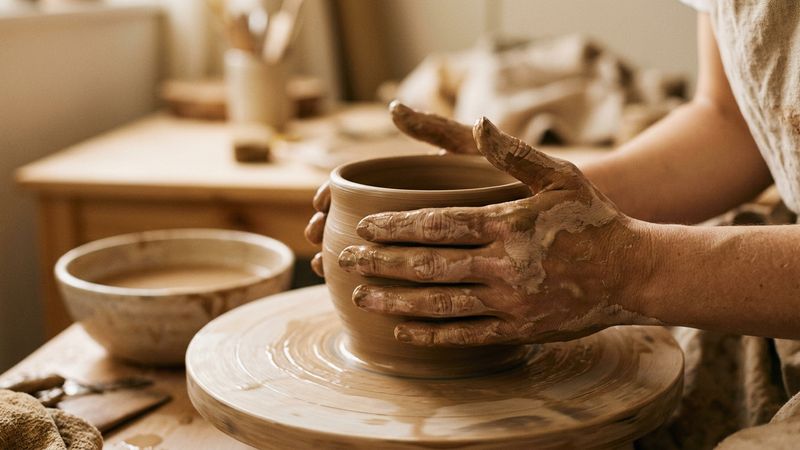
The substance is the irreplaceable connection between mind and body required to produce these objects. AI might write the catalogue notes, but it cannot replicate the decades of muscle memory that allow a glassblower to shape molten material at precisely the right moment, or the intuition that tells a ceramicist when the clay is ready.
Bulgarian artisans and makers worldwide are not fighting nostalgia. They are fighting for the right to make things that matter. The irregularities in a handmade object are not flaws. They are proof of presence.
Frequently Asked Questions
Q: What is Homo Faber and when does it run?
A: Homo Faber is a biennial exhibition dedicated to contemporary craft, held on San Giorgio Maggiore island in Venice. The 2026 edition, titled "An Island of Light," runs until 30 September and features work from more than 500 artisans representing 70 countries.
Q: How does craft compete with automation and mass production?
A: Craft objects assert value through singularity, irregularities, and the slowness of their creation. While AI and mass production can replicate forms, they cannot replicate the human judgment, muscle memory, and presence that define handmade work.
Q: Are Bulgarian artisans represented at Homo Faber 2026?
A: Yes, makers from Bulgaria and the broader Balkan region are among the 500 artisans participating, displaying ceramics, textiles, and other craft traditions alongside work from Japan, Lebanon, Denmark, and dozens of other countries.
The Artisan