
The Jar on the Counter That Teaches You to Wait
Прочети на български
A Sourdough Starter Sits in a Glass Jar on a Kitchen Counter in Lozenets
It has been there for six days. The woman who feeds it twice daily works in marketing. She cannot explain why she finds the ritual satisfying, only that she does.
The starter smells sharp, almost alcoholic. Small bubbles rise through the flour-and-water mixture. By tomorrow, it will be ready to leaven bread. The process requires no special equipment, no imported ingredients, no expertise beyond observation. What it demands is time and attention.
Why Sofia's Kitchens Are Fermenting Again
Bulgaria has never stopped fermenting. Kiselo mlyako, the tangy yogurt that carries the country's name in its bacterial strain (Lactobacillus bulgaricus), remains a daily staple. Pickled vegetables line pantry shelves from Plovdiv to Varna. Fermentation here is not a discovery but an inheritance.
What has changed is the intention. At Zhenski Pazar, Sofia's oldest market, vendors now sell kombucha SCOBYs alongside the usual jars of turshiya. Online groups dedicated to home fermentation have grown steadily, with members sharing photographs of their starters and troubleshooting failed batches. The practice has shifted from necessity to choice.
Three Ferments, Three Entry Points
Sourdough, kombucha, and kefir represent the accessible core of home fermentation. Each teaches something different about microbial transformation.
Sourdough requires five to seven days to establish a starter from flour and water. Wild yeast and lactobacillus bacteria colonise the mixture, creating the acids that give the bread its characteristic tang. The process is temperature-sensitive: between 18 and 25 degrees Celsius works best, which means Sofia's winters require a warm spot near a radiator.
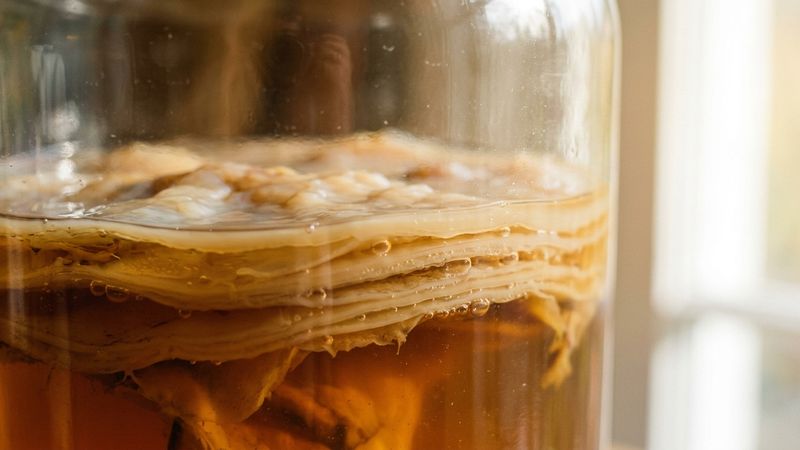
Kombucha ferments sweetened tea using a SCOBY (symbiotic culture of bacteria and yeast), a rubbery disc that floats on the liquid's surface. A batch takes seven to fourteen days. The result is fizzy, slightly sour, and tastes nothing like commercial versions.
Kefir, perhaps the most culturally resonant for Bulgarian practitioners, transforms milk into a tangy, pourable yogurt using grain-like clusters of bacteria and yeast. It ferments faster than the others, often ready within twenty-four hours.
None of these processes is difficult. All of them can fail.
The Education of Failure
A sourdough starter that smells like nail polish remover has been neglected. Kombucha that grows mould must be discarded. Kefir grains that turn slimy have been overfed. These failures are lessons.
Fermentation teaches you to read your food.
The smell of active yeast differs from spoilage. The texture of a healthy SCOBY differs from contamination. You learn to trust your senses over timers and recipes.
This iterative process appeals to people exhausted by work that produces nothing tangible. A software developer in Mladost can spend eight hours on code that may never ship. The same person can spend fifteen minutes feeding a starter and know, with certainty, that bread will follow.
What the Jar Represents
A jar of homemade kombucha costs a fraction of the commercial equivalent. A loaf of sourdough requires only flour, water, and salt. The economics are straightforward.
But the deeper value lies in agency. You know exactly what went into the jar. You controlled the process. You can adjust the sourness, the carbonation, the flavour profile. The industrial version, with its standardised taste and opaque ingredient list, offers no such transparency.
Fermentation makes the transformation visible. You watch the bubbles form. You smell the acids develop. The mystery becomes legible.
The Quiet Satisfaction
The woman in Lozenets will bake her first loaf this weekend. It will probably be dense, possibly under-proofed. She will adjust the hydration next time, or the timing, or the temperature. The second loaf will be better. The tenth will be good.
The jar on the counter asks for nothing but attention. In return, it offers something increasingly rare: a skill that belongs entirely to you.
Frequently Asked Questions
Q: How long does it take to make a sourdough starter from scratch?
A: A sourdough starter typically takes five to seven days to establish. You feed it equal parts flour and water twice daily, and it is ready when it reliably doubles in size within four to six hours of feeding.
Q: What temperature is best for home fermentation?
A: Most home ferments thrive between 18 and 25 degrees Celsius. Cooler temperatures slow fermentation; warmer temperatures speed it up but increase the risk of off-flavours or spoilage.
Q: Can I ferment kombucha and sourdough in the same kitchen?
A: Yes, but keep them at least a metre apart. Cross-contamination between different fermentation cultures is rare but possible. Store each in a clean, covered container and wash your hands between handling them.
The Artisan