Waiting for Rain in Al-Jouf: Samh and Saudi Arabia's First Slow Food Presidium
Прочети на български
Anyone who has waited for forest mushrooms after the autumn rains knows the arrangement: you do not order them, you receive them. In the northern Saudi desert the wait once ran to three seasons, with no harvest at all. A capsule the size of a fingernail sits closed in the sand for years, opening only after rain and releasing seeds so small they could pass through a sieve meant for flour. This is Samh, and its survival depends on a question no supply chain can answer: will the rains come?
In the Al-Jouf region of northern Saudi Arabia, communities have gathered this wild desert seed for generations. Those three empty seasons came before the Slow Food Presidium was established. The rains simply did not arrive, and the plant that carries centuries of knowledge almost disappeared, taking the knowledge with it.
The Samh Presidium is the first of its kind in Saudi Arabia - an unusual thing to build around a harvest nobody can promise. That is the point of the Slow Food Presidia model: where a food depends on conditions humans cannot control, protection cannot mean guaranteeing supply. It means keeping the community and its knowledge intact between one good year and the next.
The Plant and Its Patience
Samh (Mesembryanthemum forsskalei Hochst.) belongs to the fig marigold family, a small annual succulent spreading in low mats across the sand. In wet months, it grows fleshy and green. As the season closes, it turns red, pink, and finally straw-coloured.
Each branch ends in a kaabar, a capsule with a beaked top holding five chambers that stays shut until water touches it, then opens and releases the sabeeb: seeds tiny, smooth, and brown, about a millimetre long.
Left inside the capsule, these seeds keep for years. Roasted and ground in the raha, the traditional hand mill, they yield a fine dark flour deepening towards cocoa with the roast. The aroma is nutty, the texture soft, free of grit.
Reading the Season Together
There is no fixed quantity of Samh in a year. The community reads the season collectively and agrees when gathering begins, typically in August and September, when the plant stands dry in the field. Hand gathering is the reference method, and enough seed is always left for the stand to renew itself.
This is the opposite of supply-chain thinking. It requires trust, collective knowledge, and acceptance of natural limits. The Presidium covers Sakaka, Dumat Al-Jandal, Tabarjal, Al-Qurayyat, and wild stands within the King Salman Royal Reserve. Producers hold that the reach of Samh traces the identity of the region itself.
Processing as Knowledge Transfer
Transformation begins with a slow sequence of gestures.
On the baidar, the threshing floor, plants are beaten so capsules release their contents. Then comes tadhriyah, when air lifts away straw, followed by tasawwul, the patient removal of sand, stones, and twigs. Through ghirbalah, light chaff is sieved out.
After soaking, capsules open and seed settles clean before drying under the sun. The next passage, nakhl, is decisive because it determines flour cleanliness. Only after this final cleaning is Samh roasted, and only after roasting is it ground. The order is essential: roasted before milled, never after. Only pure Samh flour, with no additions, carries the Presidium name.
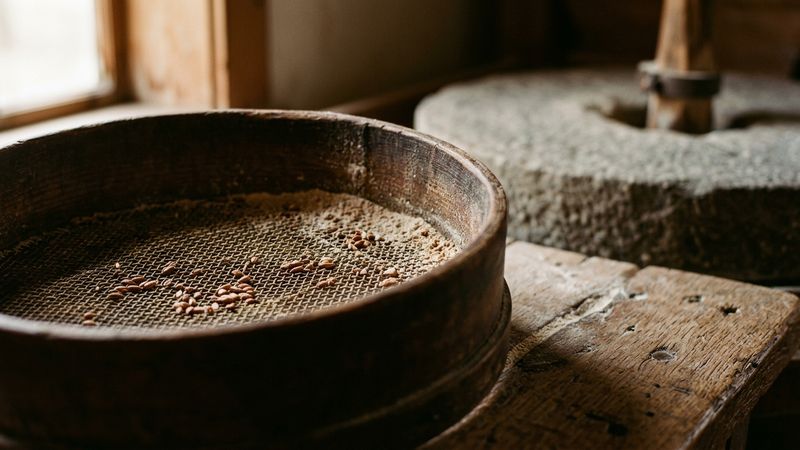
Traditional preparations include Al-Bekailah with dates and clarified butter, Aseedah cooked with milk or butter, and Samh bread. Producers say the best way to taste the year is simplest: dipping dates directly into freshly roasted flour. Unmilled seed keeps for years inside its capsule. The flour is more perishable, stored in glass, paper, or board, never plastic.
What This Teaches
Communities that protect foods tied to their specific ecology are not nostalgic. They are radical. The Samh Presidium offers a blueprint: protection requires reading the land, agreeing on limits, and passing knowledge through each step of transformation.
Next season the rains will come or they will not, and nobody in Al-Jouf gets a vote on it. What happens after they arrive is the part that belongs to people - and unlike the weather, it can be taught.
Frequently Asked Questions
Q: What is a Slow Food Presidium and how does it differ from a certification label?
A: A Slow Food Presidium is a community-led project protecting at-risk food productions, traditional knowledge, and local ecosystems. Unlike certification labels that verify compliance with standards, Presidia bring together producers who follow shared guidelines rooted in their specific territory and actively work to keep endangered food cultures alive.
Q: Why can Samh not be cultivated or farmed commercially?
A: Samh is a wild annual succulent whose growth depends entirely on desert rainfall. Its yield cannot be forced or guaranteed because the plant appears only when ecological conditions allow it. Three seasons before the Presidium was founded, there was no harvest at all due to lack of rain.
Q: What is the correct processing order for Samh flour?
A: Samh must be roasted before milling, never after. The sequence is: beating on the threshing floor, winnowing, sand removal, sieving, soaking, drying, final cleaning (nakhl), roasting, then grinding in the raha hand mill. Only pure Samh flour with no additions carries the Presidium name.
The Artisan