What a Calabrian Bean Teaches About Heritage You Can Taste
Прочети на български
The Pappaluni bean does not look like much. Pale, flat, shaped like a butter bean but slightly larger. It grows on vines that climb wooden stakes in the Aspromonte mountains of southern Italy, at altitudes between 700 and 1,300 metres, where the air is thin and the growing season is short.
And yet this bean, which has been selectively cultivated in the same region for centuries, was recently registered in the ARSAC Regional Biodiversity Registry and recognised at Slow Beans 2024. Procedures are now underway to establish a dedicated Slow Food Presidium for it.
Why does any of this matter to someone reading from Sofia?
The Same Conversation, Different Mountains
Bulgaria has its own heirloom beans. The Smilyan bean from the Rhodope Mountains, grown at similar altitudes, carries the same story: a microclimate that limits yield but concentrates flavour, generations of farmers who saved seeds and selected for taste rather than volume, and a creamy texture that industrial varieties cannot replicate.
The Pappaluni and the Smilyan bean are cousins, separated by the Adriatic but shaped by the same logic. Both exist because someone decided that quality mattered more than efficiency. Both are now protected by registries and slow food movements because that decision is no longer the default.
Biodiversity Preserved in Food
In Delianuova, the Pappaluni bean is traditionally served in hearty soups, stews, or paired with pasta. The recipe for Pasta e Pappaluni has been documented on dolcidifrolla.it.
But the bean is only one thread. The same region produces extra virgin olive oil from Sinopolese and Ottobratica cultivars, pressed from trees that are, in some cases, several centuries old. The oil has an intense, fruity flavour with herbaceous notes and a light peppery finish. Producers like Azienda Agricola Licastro, Oleificio Perrone, and Tenute Loria continue this tradition using techniques that honour the raw material.
Honey from the area captures the nuances of local flora: citrus blossoms from the groves, chestnut trees from the higher slopes. Apicoltura Carbone, Apicoltura Gangemi, and Guadagnino are among the producers whose selections offer a sensory map of the Aspromonte landscape.
Father to Son, Recipe to Recipe
Thirty years ago, a pastry maker named Pasquale Battista created a dessert called the Deliese. Two soft ladyfinger biscuits frame a layer of delicate cream, finished with a dusting of sugar and the cake's name piped in chocolate. Today, it can only be found at Pasticceria Carbone, on Via Roma 43 in Delianuova.
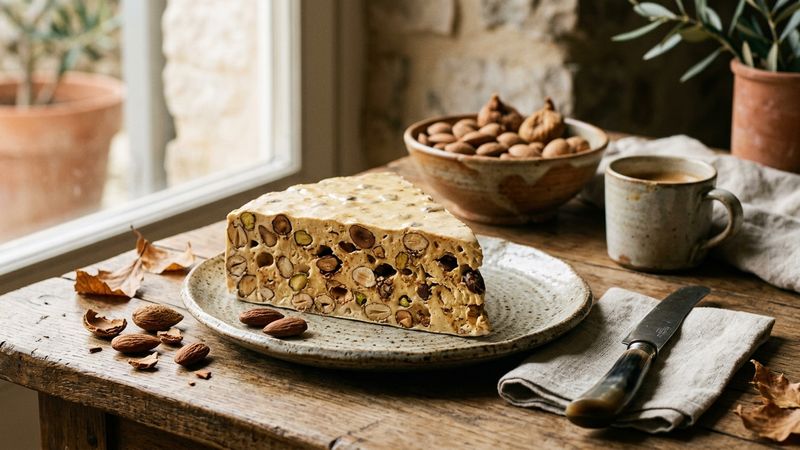
A few streets away, Pasticceria Scutellà produces torrone, the almond and honey nougat that has been made by the same family since . Don Rocco started it. His descendants continue it. The recipe has not changed because it did not need to.
This is what craft transmission looks like: not a frozen tradition, but a living practice.
The techniques evolve. The equipment improves. The commitment to quality remains.
The Flavour Is Geographic
In autumn, the forests around Delianuova fill with porcini mushrooms. Local restaurants like Lo Chalet and La Vecchia Segheria prepare them in ways that range from traditional recipes to modern reinterpretations. The mushrooms are among the finest in the region for aroma and flavour, a direct result of the Aspromonte's particular ecosystem.
You cannot replicate this in a factory. The flavour is geographic, the same principle that makes Bulgarian rose oil irreplaceable, or why honey from the Strandzha region tastes different from honey produced fifty kilometres away.
Resistance to Flattening
Understanding where food comes from is an act of cultural respect. The Pappaluni bean exists because farmers in the Aspromonte decided, for centuries, that this particular variety was worth preserving. The Smilyan bean exists for the same reason. So does the Deliese pastry, the Scutellà torrone, the olive oil pressed from trees older than most nations.
These are not relics. They are proof that heritage and quality are inseparable.
Frequently Asked Questions
Q: What makes heirloom beans like the Pappaluni different from commercial varieties?
A: Heirloom beans are selectively cultivated over centuries for flavour and texture rather than yield or uniformity. The Pappaluni only thrives at altitudes between 700 and 1,300 metres, producing a creamy texture that industrial varieties cannot replicate.
Q: How do Slow Food Presidia protect traditional food products?
A: Slow Food Presidia support small-scale producers, preserve traditional techniques, and protect heirloom varieties from extinction. The Pappaluni bean is currently undergoing procedures to establish a dedicated Presidium following its recognition at Slow Beans 2024.
Q: Why does terroir matter for products beyond wine?
A: Terroir, the combination of soil, climate, altitude, and local flora, directly shapes the flavour of honey, olive oil, beans, and mushrooms. Aspromonte honey tastes of citrus and chestnut because those are the flowers bees gather nectar from in that specific landscape.
The Artisan