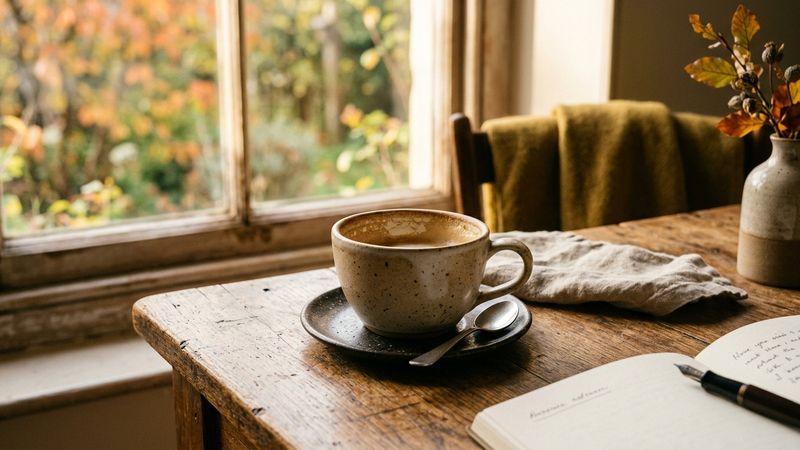
Books & Bricks sits across from Amar Singh College in Srinagar, Kashmir. Stationery shops line the roadside. The usual university rush fills the streets. Inside, something shifts. Books stack on wooden shelves. Old newspaper clippings decorate the walls. Exposed brickwork lends the room a warmth that feels both curated and alive.
Anam Khan, 34, greets regulars by name, recommends books, pauses for conversation. In one corner, two friends discuss geopolitics over cappuccinos. Nearby, a woman works through her lunch break, laptop open and coffee cooling beside her. It is the kind of place where an afternoon can disappear unnoticed.
In Sofia, where neighbourhoods are rapidly densifying and remote work has become common, the question becomes urgent: where do people actually belong? The city has coffee culture. But does it have places where you can sit for hours without obligation, where strangers become regulars, where work and community coexist without ceremony?
The Coffeehouse as Social Infrastructure
Cafes as gathering places are not new to Kashmir. The India Coffee House on Srinagar's Residency Road was once a vibrant meeting place for intellectuals, journalists, and activists during the 1970s and 1980s, carrying the literary energy associated with coffeehouses of the Beat Generation.
Decades of political instability disrupted this tradition. Today, a new generation of women entrepreneurs are deliberately rebuilding it. The model is not foreign to Bulgarian urban life either. Coffeehouses and kafene have always been social anchors here. What Srinagar's cafe owners are doing is revival, not invention.
Khan grew up in Kashmir, studied conflict analysis at Jamia Millia Islamia University in Delhi, and built a career in public health communications with USAID. Books & Bricks opened in 2015. By early 2019, it was struggling. Khan bought half of it, bringing more philosophy than capital. She renovated the space, made it more open.
Anam Khan
I wanted this place to be inclusive.
Young writers arrived with poems. Lawyers, journalists, and artists followed.
Three Models of the Same Need
A few kilometres away, Maria Bilal Lone, 34, runs Lounge by Just Baked near the city's main tuition hub. She grew up in Kupwara, lived abroad, then returned to join her family's bakery business. Two years ago, she built the lounge with a family friend.
The place became popular for book readings, poetry nights, live music, cake-decorating workshops. More quietly, it became a comfortable space for young women and remote workers.
Maria Bilal Lone
I often see young women sitting here for hours, working on their laptops or just reading a book. It's a safe place where they don't have to justify why they're here.
A third model emerged with Délifrance Kashmir, branded locally as Sucre and Spice. Khair Ull Nissa, 50, runs it as the first international franchise in Kashmir. Born into a business family, she left the region at 17, earned a master's from the University of Leeds, and spent decades abroad before returning. She sources a specific blend: 85 percent Arabica-Robusta, with 55 percent Ethiopian and 30 percent Indian Arabica.
On a rainy evening, the cafe hosted its first coffee cup meetup for young entrepreneurs.
No stage, no formal speeches, just conversation over espresso.
Khair Ull Nissa
Безопасността понякога изглежда като тиха чаша кафе и собствено пространство.
I see cafes as the new community centers. We don't have many public spaces where people can just show up and be part of something.
The Luxury of Permission
A Books & Bricks regular put it simply:
There was no place like this when I was growing up. You either stayed home, or you went to a restaurant where you had to order a whole meal. Now I can come here with my laptop, order a coffee, and stay for long hours. It's a luxury.
The luxury is not the coffee. It is permission to belong without transaction. Time without obligation. Community without ceremony.
Seven years after joining the cafe, Khan watches customers come and go.
Anam Khan
The coffee may be new, but the impulse behind the cafe is older: a search for a place to belong.
Gathering places are not luxuries. They are infrastructure.
Frequently Asked Questions
Q: What is a third space and why does it matter for urban communities?
A: A third space is a public gathering place separate from home and work where people can meet, work, or simply exist without obligation. These spaces build social resilience by creating informal networks of connection and mentorship that formal institutions cannot replicate.
Q: How are women entrepreneurs shaping cafe culture in Srinagar?
A: Three women, Anam Khan, Maria Bilal Lone, and Khair Ull Nissa, have built distinct models: an independent bookish cafe, a hybrid bakery-event space, and an international franchise with local intention. All three deliberately designed their spaces for inclusion and community building rather than pure commerce.
Q: What makes a cafe function as community infrastructure rather than just a business?
A: Intentional design that welcomes people to stay without requiring continuous purchases, programming that brings diverse groups together, and owners who prioritise belonging over transaction. The key is permission: people can sit for hours without justifying their presence.
The Slowmade Letter: what happened in the city this week, gathered into one letter.
By subscribing you agree to receive the Slowmade Letter once a week at this address. You can unsubscribe with one click, at any time. How we handle your data
Analytics cookies
We use Google Analytics and Microsoft Clarity to understand which stories get read and how you move around the site. Nothing is recorded without your consent. The cookies needed to sign in always work. Learn more