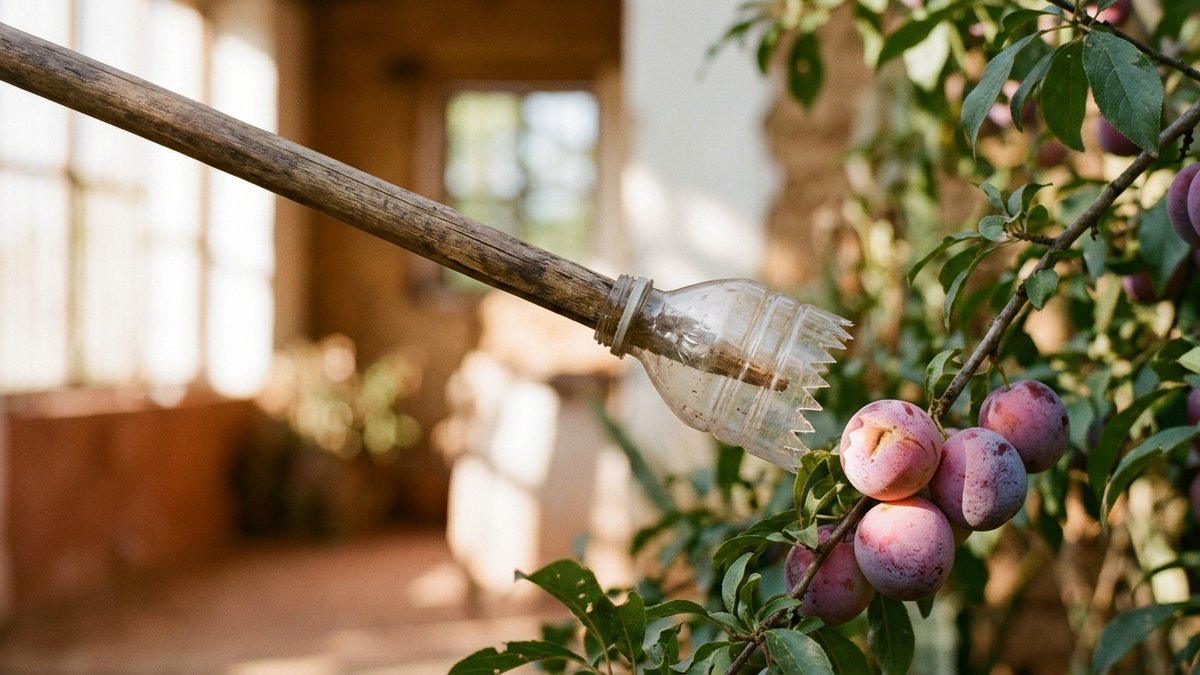
That is all Julia Alcira Rozo needed to learn how to pick plums on a farm in Colombia's Atlántico department, a coastal region where the Caribbean meets the Magdalena River. The bottle, cut and attached to the stick, becomes a harvesting tool that farmers have used for generations. After the picking came the sorting, then explanations of how the fruit transforms into dulces, mermeladas, and preserves that carry the taste of this particular soil.
Julia runs Interdestinos de Colombia, a tourism operation. She came to observe, to assess whether these farm visits could work for her clients. What she found was something harder to package: knowledge that moves through hands, not brochures.
The Rhodopes Face the Same Question
Rural regions across Bulgaria know this pressure. In the Rhodopes, the Danube Plain, around Pirin, young people leave. Traditional crops lose economic viability. The temptation is either to industrialise or to turn heritage into a shallow folk experience for city visitors who want a photo and a jar of honey.
The TUI Field To Fork Atlántico Colombia project, funded by the TUI Foundation and executed by Slow Food alongside local partner Corporación Sabores & Saberes, offers a different model. What if Bulgarian cheese makers, beekeepers, and weavers could sell directly to consumers and host small groups of learners on their own terms?
Seeds First, Visitors Second
The Colombian project did not start by designing a tourism product. It started with what already existed: native seeds, family production units, recipes passed between generations.
The numbers tell a story of scale without spectacle. The initiative recovered 1,000 square metres through agroecological practices. It connected 386 people from 256 families, working across 67 family production units and 10 community initiatives. Sixty training sessions covered agroecology, food sovereignty, heritage, costs, service, and experience design.
The principle: tourism is a secondary income stream, not the reason to farm.
Questions a Label Cannot Answer
The Mercado de la Tradición held 11 direct-sales events where producers met consumers face to face. A buyer could ask: How was this grown? When was it harvested? How do you prepare it?
For producers, this is market feedback, dignity, and a chance to explain their work. The exchange connects direct sales with farm visits and workshops. In both cases, food becomes a way to know the people who produce it.
Julia observed the importance of alliances:
Julia Alcira Rozo
The guide, the transporter, the marketer, the one who promotes the destination.
She also offered a caution:
Julia Alcira Rozo
If you don't promote it, you won't sell it.
Всяка нишка носи история, но без глас тя остава нечута
Flow Cacao, a bean-to-bar producer working with direct sourcing, operates on similar principles.
The relationship between maker and buyer is not a marketing story. It is the infrastructure that makes quality possible.
180 Visitors, 20 Pilot Experiences
Twenty pilot experiences. Twenty-four families. Twenty-two production units. One hundred and eighty visitors, of whom 171 were Colombian nationals and nine came from abroad. Farm walks, cooking workshops, food and beverage services.
The goal was feedback and adjustment, not scaling. Julia recommended that visitors participate more actively, perhaps making pastries or plum sweets themselves. She noted that kitchen infrastructure needs improvement before expansion.
The training programme enrolled 106 people in Agroalimentary Agents with Tourism Focus over 96 hours. Fifty maintained active participation. Twenty-one received certification. Twenty-three coordination spaces brought together tourism, education, culture, and media entities.
What Remains Open
The project did not formalise a permanent Mercado de la Tierra within its timeline. Not every outcome was achieved.
The question that remains is not only how many people will visit these initiatives, but how those visits can help maintain the crops, crafts, and cuisines that give them meaning.
What would it look like if Bulgarian rural communities could decide whether, when, and how to welcome visitors? If tourism income supported their primary work rather than replacing it?
The value of a seed, a recipe, or a skill does not depend on a visitor arriving. But if visitors come on the community's terms, everyone benefits.
Frequently Asked Questions
Q: What is the TUI Field To Fork model and how does it differ from typical agritourism?
A: The TUI Field To Fork model, as implemented in Colombia's Atlántico region, starts with existing agricultural practices and community knowledge rather than designing a tourism product first. It connects agroecology, direct sales, and community-led tourism, treating visitor experiences as a secondary income stream that supports primary production.
Q: How can direct sales events benefit small-scale food producers?
A: Direct sales events like the Mercado de la Tradición allow producers to receive immediate market feedback, explain their methods, and build relationships with consumers. Across 11 events in the Atlántico project, families gained experience in short-circuit commercialisation, though formalising a permanent market proved challenging within the project timeline.
Q: What training is needed for farmers to host tourism experiences?
A: The Atlántico project offered 96 hours of Agroalimentary Agents with Tourism Focus training covering agroecology, food sovereignty, heritage, costs, service, and experience design. Of 106 enrolled participants, 21 received certification. Practical infrastructure improvements were also identified as necessary before expanding visitor capacity.
The Slowmade Letter: what happened in the city this week, gathered into one letter.
By subscribing you agree to receive the Slowmade Letter once a week at this address. You can unsubscribe with one click, at any time. How we handle your data
Analytics cookies
We use Google Analytics and Microsoft Clarity to understand which stories get read and how you move around the site. Nothing is recorded without your consent. The cookies needed to sign in always work. Learn more