Britain's First Home-Grown Chocolate Bar in 94 Years
Прочети на български
Cocoa grows naturally only within 20 degrees of the equator, and Britain sits nowhere near that band. Which is why a bar of chocolate made this summer from cocoa grown in a Berkshire glasshouse, with British milk and British sugar, is the first of its kind since 1932.
Maha Khan, a food security master's student at the University of Reading, made it herself, starting with pods she picked in the university's glasshouses. Six bars of chocolate that never left Reading.
648,000 Tonnes of Missing Cocoa
For anyone following craft chocolate in Sofia or elsewhere in Europe, this story isn't about British agricultural curiosity. Bulgaria imports virtually all of its cocoa from tropical regions now facing severe climate disruption. Most of it grows in West Africa, where the International Cocoa Organization reports production dropped 12.9% between 2022-23 and 2023-24. That's 648,000 tonnes of cocoa that didn't exist.
The Reading 100 bar isn't a business model. It's a mirror.
300 Varieties in a Berkshire Glasshouse
The cocoa came from the University of Reading's International Cocoa Quarantine Centre, a facility handling 97% of the world's international cocoa plant movement. The centre houses over 300 cocoa varieties in climate-controlled glasshouses, quarantining plant material for two years to prevent diseases like cacao swollen shoot virus.
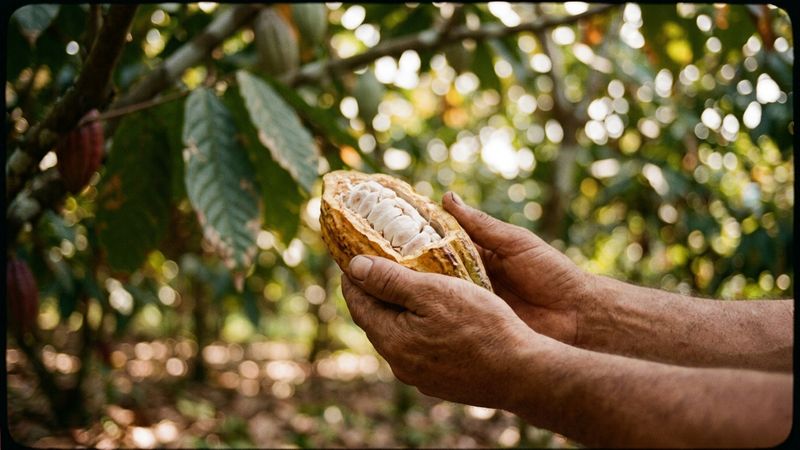
The pods Khan used would normally be discarded. Instead, she followed the traditional bean-to-bar process by hand: harvest, ferment for seven to ten days, dry in the sun, roast, winnow to separate nibs from shells, grind, blend with milk and sugar, and mould. Each pod takes roughly six months to mature.
Maha Khan
It has been amazing to follow the entire chocolate-making process, from pod to bean to bar, without leaving Reading.
One Bar for a Future Queen
The only other person known to have eaten 100% British chocolate was Princess Elizabeth in 1932. She was six years old. Rowntree's, the York confectionery company, grew a cocoa plant in a glasshouse at their headquarters, produced a single bar, and gifted it to the future queen. No commercial venture followed.
Ninety-four years passed before Khan's bar.
$2,500 to $12,000 in Eighteen Months
Cocoa trees require conditions that don't exist in Berkshire: temperatures between 18 and 32 degrees Celsius, high humidity, heavy rainfall. West Africa produces 65 to 70% of the global supply.
In 2023 and 2024, Côte d'Ivoire and Ghana experienced devastating weather.
Heavy rainfall during Ghana's dry season triggered widespread black pod disease. A severe drought followed, affecting over one million people. Côte d'Ivoire's production fell by 20 to 25%. Cocoa prices, which had hovered around $2,500 per tonne for a decade, spiked past $12,000 per tonne in late 2024.
Climate intelligence firm ClimateAi projects that roughly half the land currently suitable for cocoa cultivation could become unusable by 2050.
Maha Khan
This British bar of chocolate highlights the precarious nature of our food supplies. Cocoa plants are very sensitive to changes in temperature and rainfall, and climate change is already causing problems in countries that produce most of the world's cocoa.
Six Bars and a Question
The UK chocolate market is worth £10.4 billion annually. Bulgaria's is smaller but growing, with craft producers building reputations on single-origin bars sourced from the same vulnerable regions.
Prof Carol Wagstaff, director of AgriFood Futures at the University of Reading
The UK chocolate industry rests on a supply chain that starts thousands of miles away in the tropics of Africa, South America and Asia. A resilient global market is crucial to the many smallholder farmers who underpin the industry and find themselves farming in some of the regions most exposed to risks from climate change.
Six bars were never going to fix a supply chain that begins thousands of miles from Berkshire, and Khan has not claimed otherwise. But she has tasted something most people in Britain never will: the white pulp around a freshly picked cocoa bean. It tastes like lychee.
Frequently Asked Questions
Q: What is the Reading 100 Chocolate Bar?
A: The Reading 100 is the first chocolate bar made entirely from British ingredients since 1932, created by food security researcher Maha Khan at the University of Reading. She used cocoa grown in the university's climate-controlled quarantine centre, combined with British milk and sugar.
Q: Why can't cocoa be grown commercially in the UK?
A: Cocoa trees require tropical conditions: temperatures between 18 and 32°C, high humidity, and heavy rainfall. They grow naturally only within 20 degrees of the equator. The UK's climate-controlled glasshouses are research facilities, not viable for commercial production.
Q: How is climate change affecting global cocoa supply?
A: Global cocoa production dropped 12.9% between 2022-23 and 2023-24, from 5.016 million tonnes to 4.368 million tonnes. Extreme weather in West Africa caused disease outbreaks and drought, pushing prices from $2,500 to over $12,000 per tonne. ClimateAi projects half of suitable cocoa land could become unusable by 2050.
The Artisan