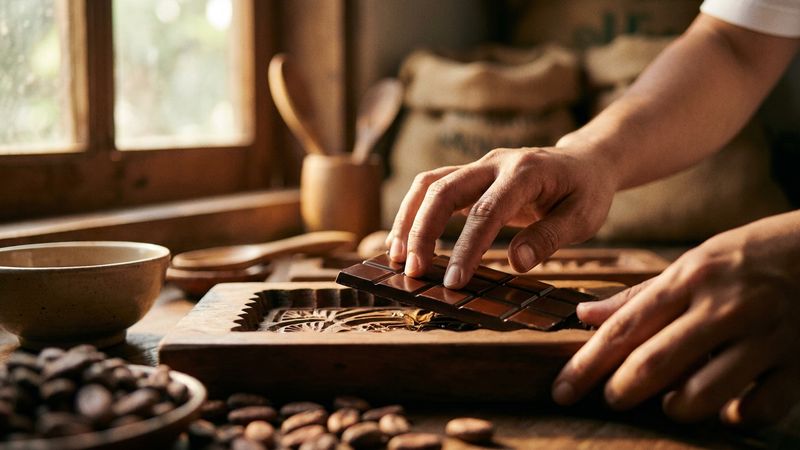
The smell of roasting cacao beans is not subtle. It fills a room the way coffee does, but darker, earthier, with a slight acidity that catches the back of the throat. In Tagbilaran City, on the Philippine island of Bohol, ten participants stood around a worktable on July 4th, their hands stained with cacao butter, learning something most chocolate consumers never consider: that the bar in their pocket took weeks of fermentation, precise temperature control, and a chain of decisions stretching back to a specific tree on a specific hillside.
This is the Make Your Own Chocolate workshop at Dalareich Chocolate Studio, and it represents something larger than a tourist activity.
The Sofia Parallel
For those watching craft food culture develop in Sofia, the Bohol model raises an obvious question: what would this look like here? The city already has a growing appetite for experiential food education. Coffee roasters run cuppings. Natural wine bars host producer tastings. But the workshop format, where participants actually make the product themselves, remains underexplored.
Flow Cacao, operating from Sofia with single-origin ceremonial cacao, works from a similar philosophy: sourcing traceable beans, teaching customers about fermentation and flavour development, treating chocolate as craft rather than commodity. Bulgarian food traditions offer rich material too. Fermentation knowledge runs deep here: yogurt, cheese, preserved vegetables. The techniques translate. What's missing is the bridge between heritage knowledge and contemporary workshop culture.
Three Activities, One Revelation
The Dalareich workshop structures learning around three hands-on activities. First, participants make traditional tableya, the Filipino chocolate tablets, wrapping them in banana leaves the way Polot's family has done since 1994. Second, they craft personalised chocolate bars, choosing flavours and designs. Third, a professional tasting session teaches them to identify origin-specific characteristics.
The progression matters. By the end, participants understand that chocolate making is not intuitive.
The workshop experience is a blend of fun, excitement and random bits of knowledge that make it even sweeter.
Twin Javier, 34-year-old entrepreneur
Helen Castaño-Alagadmo, 49, put it more directly: We also realized that making chocolate is not as easy as it looks.
The Chocolatier's Path
Dalareich Polot, 38, runs the studio. She studied chocolate processing and food engineering at Ghent University in Belgium on a scholarship, but her education started earlier. Her mother, Elsa, worked as a street sweeper. Her father, Ricardo, drove a tricycle. The family made and sold tableya to supplement their income.
She established Dalareich Chocolate House in 2017, Bohol's first chocolate factory, expanding the family business into bean-to-bar production. The facility employs housewives and working students. The workshops add another revenue stream while serving a larger purpose.
I think it is a good thing that we can promote to tourists not just the Chocolate Hills, but also the experience of making your own chocolate on the island of the Chocolate Hills.
Dalareich Polot
Зад всяка туристическа дестинация се крие история, която заслужава да бъде разказана с ръце.
The Craft Chocolate Argument
Polot's ambition extends beyond her studio.
The craft chocolate industry in the Philippines is still small, but we are doing our best to promote Filipino craft chocolate to the world market because we actually have some of the best cacao beans in the world, she said.
This is not marketing language. Fine flavour cacao, the designation used by the International Cocoa Organization for beans with distinctive aromatic profiles, represents roughly five to eight percent of global production. The Philippines grows it. So does Ecuador, Madagascar, and parts of the Caribbean. The challenge is not quality but recognition.
Workshops address this directly. A participant who has fermented cacao, monitored temperatures, and tasted the difference between origins becomes an advocate. They return home understanding why a craft bar costs six or seven euros while a mass-market bar costs one.
What This Means for Makers Elsewhere
The Dalareich model is replicable. It requires a producer with genuine expertise, a space that can accommodate small groups, and programming that balances education with experience. The investment is modest compared to the return: diversified revenue, customer education, and word-of-mouth that advertising cannot buy.
For Sofia's artisan producers, the opportunity is clear. The city's expat community and visiting professionals already seek out craft experiences. What remains is the decision to treat the workshop not as a side project but as a core part of how craft culture sustains itself.
The smell of roasting cacao is not subtle. Neither is the lesson.
Frequently Asked Questions
Q: What activities are included in the Dalareich chocolate workshop?
A: Participants complete three hands-on activities: making traditional tableya wrapped in banana leaves, crafting personalised chocolate bars with chosen flavours and designs, and participating in a professional tasting session to identify origin-specific characteristics.
Q: Who founded Dalareich Chocolate House and what is their background?
A: Dalareich Polot, 38, founded the company in 2017. She studied chocolate processing and food engineering at Ghent University in Belgium on a scholarship, building on her family's tableya business that began in 1994.
Q: How do chocolate workshops support local cacao farming communities?
A: Workshops create additional revenue streams for producers, employ local workers including housewives and students, and educate consumers about craft chocolate's value. This increased awareness helps justify premium pricing for locally grown cacao, supporting farmer livelihoods.
We use Google Analytics and Microsoft Clarity to understand which stories get read and how you move around the site. Nothing is recorded without your consent. The cookies needed to sign in always work. Learn more