
Five Rooms, One Day: How a Cafe in Almaty Designed Time Itself
Прочети на български
The morning section glows warm yellow and soft pink. By evening, the same building has shifted into something deeper, quieter, more intimate. Nothing has moved except the light and the visitor.
This is Six Coffee + Wine in Almaty, Kazakhstan, a 300-square-metre cafe and wine bar that treats the passage of time as its primary design material. Completed in 2025 by local architecture studio NAAW, the space unfolds across five interconnected rooms, each calibrated to a different moment in the day. You enter in the morning and exit in the evening, even if you've only been there an hour.
For anyone in Sofia watching the city's specialty coffee culture mature, this project offers something worth studying. Both cities share a Soviet-era architectural inheritance, a growing appetite for intentional spaces, and the question of what to do with buildings designed for a different century. Almaty's answer is not demolition or nostalgia, but reinterpretation.
The Gradient as Narrative
NAAW describes the project as "a spatial transition, from morning to evening, from coffee to wine." The five halls are not themed rooms in the decorative sense. They are chapters in a single story, told through shifting palettes, light modulation, and material density.
The walls throughout are clad in shell limestone, a material containing visible shell fragments that appears on Almaty landmarks including the Kazakhstan Hotel, the Palace of the Republic, and the Arasan Baths. Rather than importing luxury finishes, NAAW chose to work with what the city already knows. The terrazzo flooring is tinted to match the limestone's tone, with marble inlays appearing deeper into the plan as the day progresses.
Custom shutters and stained glass control how much daylight enters each room. The stained glass, created in collaboration with artist Zhanel Shakhan, features a gradient that mirrors the cafe's day-to-night arc. Hidden within the glass are stylised miniatures of the cafe's own interior, a detail most visitors will never notice but which rewards those who look closely.
Local Craft as Design Language
The project's most instructive lesson may be its sourcing. Rather than filling the space with imported furniture, NAAW commissioned local makers and artists throughout.
Photography by Almaty-based Bauyrzhan Sabit appears on the walls. A felt tapestry by local design studio Dunie anchors the morning section. Seating comes from Aq Objects, whose designs draw from furniture traditionally used inside yurts, paired with sculptural Plopp chairs that introduce a contrasting manufacturing technique. The corridor leading to the kitchen is fully clad in gradient panels developed with For Walls, a local brand specialising in architectural surfaces.
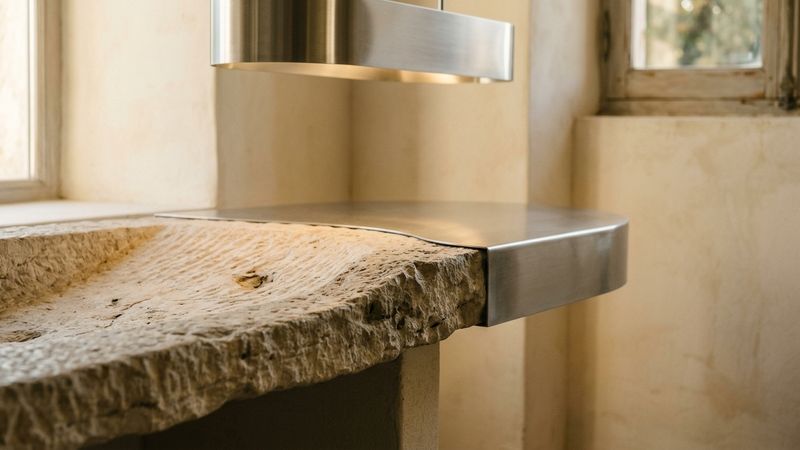
The bar counter itself, carved from shell limestone in undulating forms, is anchored by a custom curved stainless steel light fixture. It functions as the spatial and conceptual heart of the project, the point where morning and evening meet.
In Sofia, Blue Bag Specialty Coffee works with a parallel philosophy, sourcing from verified farms and treating each batch as a deliberate choice rather than a commodity transaction.
Like NAAW's approach in Almaty, this reflects a broader shift in how cities are thinking about coffee culture: not as convenience, but as ritual.
Light as the Protagonist
What makes Six Coffee + Wine work is not the materials alone but how they interact with light. The morning-oriented section uses warm yellows and soft pinks. As visitors move through the space, the palette deepens. Lighting fixtures from Pholc, Verpan, and &Tradition were selected to complement the natural light at different times of day.
The effect is cumulative. You do not notice the transition happening. You simply arrive at the evening section and realise the space has changed around you. The design creates permission to slow down by making the passage of time visible, even beautiful.
What a Building Can Teach
Six Coffee + Wine is not a template to copy. It is a question posed in limestone and glass: what would it mean to design a space that marks time rather than ignores it?
Sofia has its own architectural inheritance, its own local makers, its own light. The question is whether the city's designers and cafe owners will treat these as constraints or as materials. Almaty's answer suggests the latter is more interesting.
Frequently Asked Questions
Q: What is the design concept behind Six Coffee + Wine in Almaty?
A: The cafe is designed as a spatial transition from morning to evening, with five interconnected rooms that shift in palette, lighting, and atmosphere. Each room represents a different moment in the day, moving from warm yellows and soft pinks in the morning section to deeper, more intimate tones in the evening areas.
Q: What local materials and collaborations were used in the project?
A: NAAW used shell limestone found on Almaty landmarks like the Kazakhstan Hotel and Arasan Baths. Local collaborations include stained glass by artist Zhanel Shakhan, photography by Bauyrzhan Sabit, felt tapestry by Dunie, yurt-inspired seating by Aq Objects, and gradient panels by For Walls.
Q: How does the cafe's design relate to specialty coffee culture?
A: The space treats coffee and wine as rituals rather than transactions, using architecture to slow visitors down and mark the passage of time. This aligns with the broader specialty coffee movement's emphasis on intentionality, craft, and the experience surrounding the drink itself.
The Flaneur