From the Mountains of Cebu to the World: One Woman's Mission to Share Sikwate
Прочети на български
A Grandmother's Recipe Crosses Continents
The reaction is almost always the same. A visitor lifts a small cup of sikwate, the traditional Filipino hot chocolate made from roasted cacao discs called tableya, and takes a first sip. Then comes the pause. Then the recognition. "This is how my grandmother made it," they say, particularly those of Hispanic or Latino descent who have gathered at one of Raquel Toquero-Choa's events in Los Angeles.
That moment of recognition across continents is precisely what Raquel has been chasing since she registered The Chocolate Chamber LLC in Los Angeles in June 2025. Since then, she and her daughter Angelie have held roughly 20 events across the United States for diplomats, organizations, and retirees. The verdict is consistent: one of the best cups of hot chocolate they have ever tasted.
For readers in Sofia and across Bulgaria, where makers are rediscovering fermented traditions and ceremonial food practices, Raquel's journey carries familiar resonance. Craft knowledge held by grandmothers is not quaint or obsolete. It is urgent and alive.
The Knowledge That Crossed Seven Rivers
Raquel grew up in Balamban, roughly 49 kilometres west of Cebu City in the Philippines. Sent to live with her grandmother Nila after her parents separated, she was seven when she first learned to make sikwate. Her grandmother nourished her with the drink to give her strength for the daily walk to school that required crossing seven rivers.
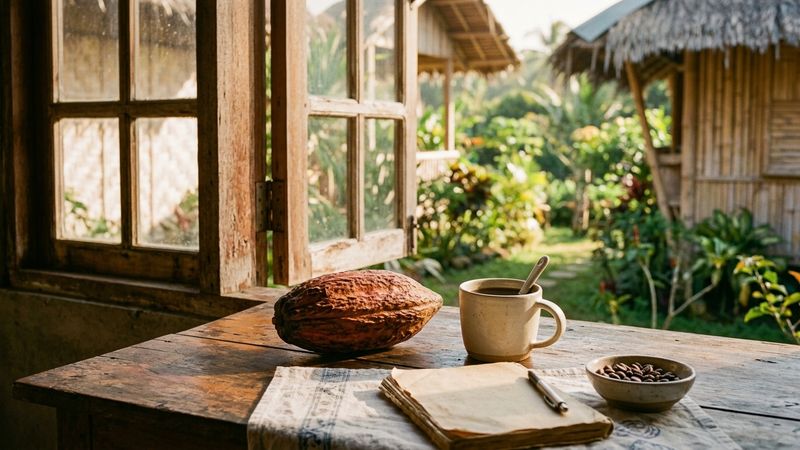
The tableya came from cacao trees on family land. None was ever sold. The discs were considered precious, reserved for women about to give birth, for the sick, for those nearing death. Tableya was offered to departed loved ones during All Saints' Day and All Souls' Day.
Years later, Raquel had her tableya tested. The results showed what her grandmother had known through practice: cacao contains iron and fiber, nutrients important during pregnancy, as well as magnesium for relaxation. The "superstitions" had scientific basis.
Hardship as Foundation
The path from Balamban to international recognition was not direct. Raquel moved to Manila as a teenager, worked as a laundry woman and garbage collector. She married at sixteen, raised eight children, became a widow after thirty years.
She never finished college but took vocational training. She worked in dress design, then event organizing. Through all of it, sikwate remained constant. Not a business idea, but a thread of continuity.
The turning point came in 2010 when an Argentine friend named Norma asked: "What do you have in the Philippines that we can export?" Raquel served sikwate. The partnership fell through, but something ignited. She began experimenting with tableya-infused dishes served from her garage in Casals Village. People started lining up.
The Order That Changed Everything
In 2012, then Agriculture Secretary Proceso Alcala asked his staff to find something uniquely Filipino for Christmas gifts. Someone at the Cocoa Foundation Philippines mentioned a woman in Cebu with a passion for cacao. After a long search, the team found Raquel's doorstep.
Alcala ordered 500,000 Philippine pesos worth of gift bags containing her tableya products.
The bags went to national media, government officials, ambassadors. Institutional validation, not marketing, expanded her market.
Today, Raquel heads Ralfe Gourmet Inc., the parent company behind The Chocolate Chamber. The product line includes traditional tableya, cacao de bola, five variants of chocolate powder, cacao nibs, and cacao-based beauty products. She operates a café at Robinson Galleria Cebu and a mobile concept called Batirol, named after the wooden whisk rolled between the palms to create sikwate's characteristic froth.
Her home, Casa de Cacao, has become an immersive cultural tour called The Chocolate Journey. School children get the Cacao Discovery Walk. Governors from the recent 19th East Asia Inter-Regional Tourism Federation General Assembly got the full Chocolate Tour.
"I want to tell the whole world that we exist in the chocolate world."
Raquel Toquero-Choa
"Sometimes, I'm amazed by how far I have reached, from the mountains of Balamban to the world."
Raquel Toquero-Choa
When makers honour what their grandmothers taught them, they do not simply preserve the past. They create something the world did not know it was missing.
Frequently Asked Questions
Q: What is sikwate and how is it different from regular hot chocolate?
A: Sikwate is a traditional Filipino hot chocolate made from tableya, discs of roasted and ground pure cacao beans. Unlike commercial hot chocolate, it contains no added sugar or milk powder. The drink is prepared by dissolving tableya in hot water and frothing it with a batirol, a wooden whisk rolled between the palms.
Q: What is tableya used for beyond drinking?
A: In Filipino tradition, tableya is used in cooking dishes like humba and pancit. Families reserve it for pregnant women, the sick, and the dying, and offer it to ancestors during All Saints' Day and All Souls' Day. Nutritional testing shows tableya contains iron, fiber, and magnesium.
Q: Where can visitors experience Raquel Choa's sikwate tradition?
A: Raquel operates The Chocolate Chamber café at Robinson Galleria Cebu and offers immersive tours at Casa de Cacao in Cebu City. In the United States, The Chocolate Chamber LLC hosts events for diplomats, organizations, and retirees, with roughly 20 events held since June 2025.
The Artisan