
The Café That Erases Itself
Прочети на български
A corner table at Café de Flore. A Dalloyau croissant, chosen over the one from the bakery down the street. A perfumer who grew up in St-Germain-des-Prés, now living in New York, returning to the place where he started.
Frédéric Malle's last meal is not about the food.
In a recent Monocle feature, the founder of Editions de Parfums Frédéric Malle explains why he chose this particular café for the hypothetical final breakfast:
If you're in a place that you're so comfortable with that it's part of you, then it is a neutral setting. The place erases itself and the people stand out more as a result.
Frédéric Malle
This is not nostalgia. It is something closer to architecture.
The Frame, Not the Picture
Malle's grandfather started Christian Dior's perfume division. Malle himself launched his own house in 2000, built on a radical premise: the perfumer, not the brand, should be the star. Each scent is a collaboration between editor and artist, the name of the nose printed on the bottle.
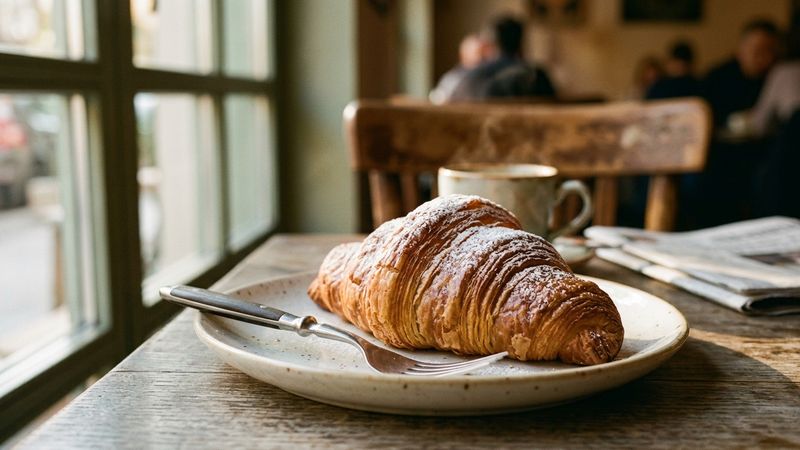
But at Café de Flore, he is not a perfumer. He is a regular. He has two preferred seats: the corner of the terrace facing the street, and the spot inside to the left, next to Marie Hélène at the till. He orders the Dalloyau croissant, never the one from Bonbonnière de Buci.
I like the idea of being committed to one side.
Frédéric Malle
The croissant itself is almost absurd in its richness. There's so much egg in there it's almost perverse. But for a last meal, he argues, you need to indulge.
What strikes me is not the indulgence. It is the specificity. The commitment to one croissant, one seat, one café.
The Continuous Feed
Malle describes his morning ritual as watching a running image of life, like a continuous feed. Not observation with a microscope, but something looser. The café becomes a frame for chance encounters. He chose Flore for his last meal partly because he wouldn't have to plan whom to invite.
Since I always run into people I know, I'd leave it up to chance to decide.
Frédéric Malle
This is how certain spaces work. They are not destinations. They are intersections. The regulars know each other by sight, by timing, by the table they always choose.
His uncle, the filmmaker Louis Malle, shot a scene from Le Feu Follet at Café de Flore. The film follows a man through St-Germain on his final day alive. Frédéric Malle hadn't thought of the connection until the interview. It's strange, he admits.
Children's Food at Adult Prices
The food at Flore is, by Malle's own description, quite basic.
French snacks, essentially. Croissants. Saucisse de Francfort. It's children's food at adult prices.
But the quality is excellent. And the simplicity is the point. A last meal is not about complexity. It is about knowing exactly what you want and choosing it without hesitation.
This philosophy runs through Malle's work in perfume: constraint as a form of excellence. Each scent is a single perfumer's vision, not a committee's compromise. The editor's role is to create the conditions for that vision to emerge, then step back.
The café works the same way. The space erases itself. The croissant is perfect. The people stand out.
The Ritual That Sustains
What Malle describes is not unique to Paris. Every city has spaces like this, if you know where to look. Cafés where the regulars have their tables, where the barista knows your order before you speak, where the morning light falls the same way every day.
In Sofia, Blue Bag Specialty Coffee operates with a similar philosophy. Head barista Francisco Lopez sources from verified farms at peak ripeness, roasting small batches that reflect the same commitment to knowing exactly what you're choosing. Loyalty to one thing, done well.
The question is not where you would have your last meal. The question is whether you have a place that has become so much a part of you that it erases itself. A corner table. A specific order. A frame for the continuous feed of life.
If you do, you already know.
Frequently Asked Questions
Q: What does Frédéric Malle mean when he says a café "erases itself"?
A: Malle describes how a space becomes so familiar that it stops demanding attention, allowing the people and moments within it to stand out. The café becomes a neutral frame rather than a focal point.
Q: Why does Malle always order the Dalloyau croissant instead of the other option?
A: He values commitment and specificity. "I like the idea of being committed to one side," he explains. The Dalloyau croissant is richer, with more egg, and represents a deliberate choice rather than a compromise.
Q: What is the connection between Café de Flore and the film Le Feu Follet?
A: The 1963 film, directed by Malle's uncle Louis Malle, includes a scene shot at Café de Flore. The film follows a man through St-Germain-des-Prés on his final day, a parallel Frédéric Malle only noticed during the interview.
The Flaneur
Frequently asked questions
What does Frédéric Malle mean when he says a café "erases itself"?
Malle describes how a space becomes so familiar that it stops demanding attention, allowing the people and moments within it to stand out. The café becomes a neutral frame rather than a focal point.
Why does Malle always order the Dalloyau croissant instead of the other option?
He values commitment and specificity. "I like the idea of being committed to one side," he explains. The Dalloyau croissant is richer, with more egg, and represents a deliberate choice rather than a compromise.
What is the connection between Café de Flore and the film Le Feu Follet?
The 1963 film, directed by Malle's uncle Louis Malle, includes a scene shot at Café de Flore. The film follows a man through St-Germain-des-Prés on his final day, a parallel Frédéric Malle only noticed during the interview.