
We Are Not Clairvoyants: Dimitar Petrovski of Ritual Coffee and Cocktails
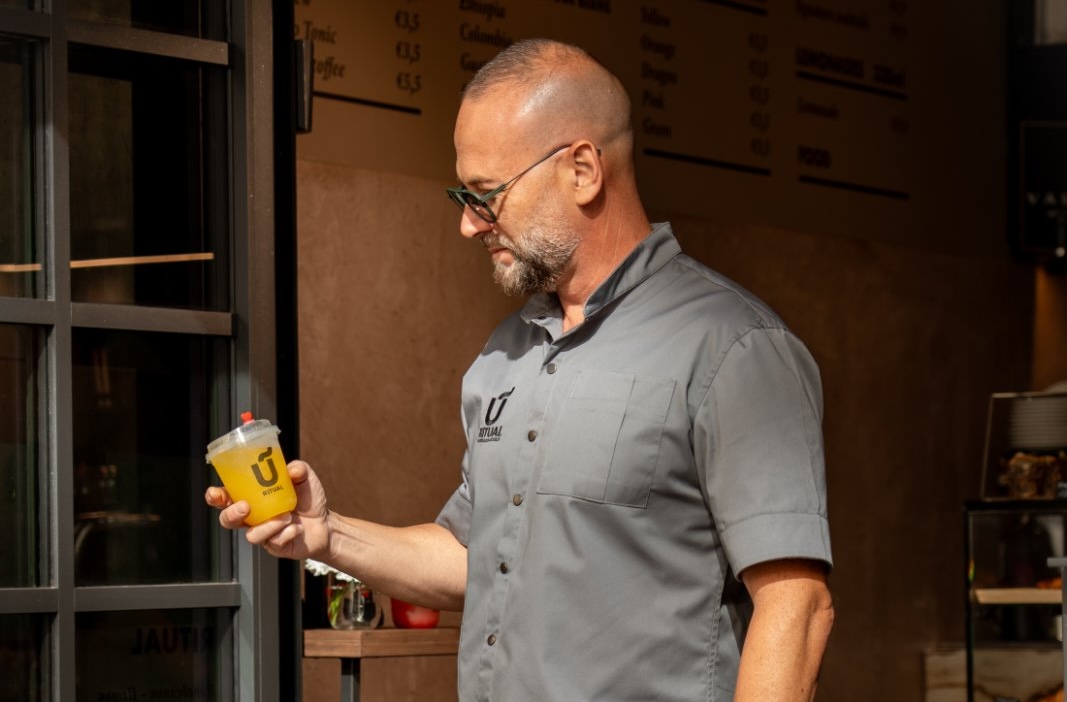
Three words run across the awning above the door: COFFEE, RITUAL, COCKTAILS. The middle one is the name of the place. It also turns out to be the answer to a question about whether the first sip of the morning is work or pleasure.
Dimitar Petrovski talks about the bar as a fixture of its neighbourhood rather than a unit of business. Ritual Coffee and Cocktails will be among the participants at Good Coffee Festival in Sofia this September. What follows comes from a Slow Made City conversation ahead of the festival - ten short questions, none of them about turnover or locations.
The neighbourhood knows you, or it does not
The first question was what a barista knows about the neighbourhood that nobody else does. The answer started with the building.
"The barista knows the building our place is in, which has historical value. He knows which street it stands on, because that street has historical value for cafe and restaurant culture in this city - Rakovska. What the barista knows is what the place used to be, and that he knows the customs and the subculture of the neighbourhood."
DIMITAR PETROVSKI, RITUAL COFFEE AND COCKTAILS
You can check the claim without going inside. To the right of the door hangs one of those Sofia plaques that explain where a street name came from: Racho Dimchev, a merchant and benefactor, honorary citizen of Lovech, who lived and worked in Milan, Marseille and Paris, returned to Bulgaria in 1887 and took up entrepreneurship and banking in Sofia. Most people walk past it on their way somewhere.
"Relations with the neighbours, that delicate business of knowing the neighbourhood and having it know you, matters enormously if you are going to be a cafe, a restaurant or a bar. So we research this in advance, so that we can fit in, so the neighbourhood accepts us and we accept it."
DIMITAR PETROVSKI, RITUAL COFFEE AND COCKTAILS
The research is not a marketing exercise. Who walks past at 8:00 and who at 16:00 decides whether batch brew is held in a flask or made to order, how often the dose changes and at what hour the grinder gets reset. A place serving both coffee and cocktails lives on two clocks at once.
A ritual, not a shift
Asked whether the first sip of the morning is work or pleasure, the answer was a single word.
"A ritual!"
DIMITAR PETROVSKI, RITUAL COFFEE AND COCKTAILS
The word is on the awning outside, so the answer is also a name. Underneath it, though, there is technique. A ritual is a fixed sequence, and repeatability is exactly what makes the morning espresso a reference point: if the parameters move every day, the first sip stops telling you anything.
The bar and the coffee measure that repeatability to different tolerances, though. A cocktail is poured with a jigger in steps of 5 ml, while an espresso is weighed on a scale that resolves to 0.1 g. Under one roof those are two different ideas of "same as yesterday", and both have to hold, in the same pair of hands.
The question of which aroma from the job he would keep forever went somewhere else entirely.
"The smell of vanilla. I have kept it since childhood."
DIMITAR PETROVSKI, RITUAL COFFEE AND COCKTAILS
The answer is interesting for what it is not. Behind the bar it smells of milk, citrus peel, ice, cleaning agent and roasted coffee. The vanilla comes from before the bar. The nose of the person at the machine is calibrated over years, but the references it compares against are personal, and almost always older than the trade.
Will he pass the craft on
Asked what he would put to the farmer who grew his beans, most people in the trade answer with flavour or processing method. This answer was about succession.
"Whether he will pass the craft on to his children, and how he trains his apprentices, his journeymen, the masters he hands the craft to."
DIMITAR PETROVSKI, RITUAL COFFEE AND COCKTAILS
The ladder is a Bulgarian one - apprentice, journeyman, master - and he lays it over a coffee farm on the other side of the world. It works better than it sounds. Processing coffee is manual work learned by being shown: when to pick, how many days on the drying beds, when to turn the lot. None of it transfers on paper.
Succession is also a real problem in the sector rather than a rhetorical question. The children of farmers move to the cities, and the knowledge of the particular plot goes with them - which slope ripens first, when the rain arrives. The traceability the specialty sector is proud of reaches the name of the farm, but rarely the question of who will take it over.
A Social Shop, not a cafe
Asked whether he reads a person by the order or by the way they wait, he rejected the premise in the first word.
"I ask questions, I do not read them. We are not clairvoyants. We ask questions and we communicate verbally, because that is the one skill that separates us from animals."
DIMITAR PETROVSKI, RITUAL COFFEE AND COCKTAILS
The refusal is a practical one. "The usual" is convenient for the bar and a trap for the guest: someone who gets the same thing every day without being asked stops trying anything new. In a room that serves coffee before noon and cocktails in the evening, the same guest at 9:00 and at 21:00 wants opposite things, so reading faces fails quickly.
"We are a social place, we are a Social Shop, somewhere people go to collect a social dividend. Not just a drink in the hand and one more coffee, but something that recharges you on a daily basis."
DIMITAR PETROVSKI, RITUAL COFFEE AND COCKTAILS
"Social dividend" is a word from accounting, dropped into a place where people usually talk about atmosphere. The difference is that a dividend pays out on a schedule and can be watched: who comes back, who brings someone along, who sits down instead of leaving with the cup.

Tolerance, paid for with humility
Asked what his most demanding customer taught him, the answer was one word, and then the arithmetic behind it.
"Tolerance. When you get that type of customer, and when you meet the other side of it, where this kind of work pushes you into a different sort of exchange and two sharp stones meet, tolerance is what you need - because we are in the business of pleasure, and pleasure walks hand in hand with humility."
DIMITAR PETROVSKI, RITUAL COFFEE AND COCKTAILS
The two sharp stones are his image and they are accurate. The guest arrives with a bad day, the person behind the bar is on their eighth hour and has six people waiting. Fatigue behind a bar rarely comes from the machine. It comes from staying courteous at the moment you least want to be.
"The business of pleasure" is just as exact. Pleasure is the product, and it does not tolerate explanations about why it did not come off today. Which makes humility less a virtue here than a working tool.
Recipes are not secrets
Asked whether he keeps a recipe as a family secret, he handed the question back.
"Oh, secrets exist to be kept, and they have nothing to do with recipes. Recipes exist to be shared. The ancient Greeks said it: shared knowledge is the greatest knowledge."
DIMITAR PETROVSKI, RITUAL COFFEE AND COCKTAILS
In specialty coffee that is closer to a norm than to generosity. Dose recipes are written on a sheet beside the grinder, competition routines are published, and extraction numbers move between bars that are otherwise competing for the same guests. The cocktail side is more closed by tradition, which makes the answer less obvious than it looks.
"A recipe takes years to perfect. And in my experience all over the world, going round cafes, restaurants and bars - with every chef, when someone puts a hand up and asks to be let in to see how it is done, there is no problem at all."
DIMITAR PETROVSKI, RITUAL COFFEE AND COCKTAILS
The logic is simple. A recipe is a list; execution is a craft. The list copies in a minute. The years do not.
The last point of control
Asked whether he has ever been ashamed of a cup he served, he said no, and then explained where the line runs.
"No, because my job is the last link before the cup, the plate, the aroma goes to the guest. That is what I try to teach my team as well. Because it is not only the cup, it is a whole palette, and before it reaches the guest the last point of control is the barista, or the bartender, or the waiter, or whoever carries it."
DIMITAR PETROVSKI, RITUAL COFFEE AND COCKTAILS
The rule has a name in kitchens - checking at the pass - and it barely exists in cafes, where the cup goes straight from the grinder to a hand. Here the responsibility is pushed out to the last person who touches it, the waiter included.
"So it is out of the question that anything goes out looking wrong. An ingredient can be missed, there can be something in the taste that is barely noticeable, and care is taken there too, but purely aesthetically, something that looks ugly is simply impossible."
DIMITAR PETROVSKI, RITUAL COFFEE AND COCKTAILS
The distinction is an honest one and worth reading slowly. What is visible gets caught reliably: spilled foam, a lopsided rosetta, a fingerprint on the glass. Taste carries a wider tolerance, because it is only checked if someone takes a sip. Between the two sits the difference between a standard that shows and a standard that is kept.
The last question was what he would make himself if he were his own first customer tomorrow morning. "An espresso, obviously," he said - no hesitation and no list of alternatives, which from someone with a cocktail menu behind him is an answer in itself.
At the stand in September, order an espresso and then ask something. The question is half of what the room was built for, and the other half is standing on the far side of the bar, waiting to be set off.
Frequently Asked Questions
Q: Why does the barista ask the guest instead of reading them by their order?
A: Because reading them is guesswork. As Dimitar Petrovski of Ritual Coffee and Cocktails puts it, "we are not clairvoyants". Asking also has a practical reason: "the usual" locks a guest into one choice, and in a room that serves coffee before noon and cocktails in the evening, the same person at 9:00 and at 21:00 wants different things.
Q: What does "Social Shop" and a social dividend mean?
A: It is how Dimitar Petrovski describes the venue: somewhere people go not only for a drink but for a social dividend, something that recharges them on a daily basis. The measure of it is who comes back, who brings someone along and who sits down instead of leaving with the cup.
Q: Are recipes shared in specialty coffee?
A: Largely yes. Dose recipes sit beside the grinder, competition routines are published, and extraction numbers move between venues competing for the same guests. Dimitar Petrovski takes the same position: secrets are kept, recipes are shared, because a recipe is a list while execution is a craft.
Q: When is Good Coffee Festival 2026 and is Ritual Coffee and Cocktails taking part?
A: Good Coffee Festival runs from 11 to 13 September 2026 in front of NDK in Sofia and brings together more than 70 participants: roasters, coffee spaces and baristas. Ritual Coffee and Cocktails is among them and Dimitar Petrovski will be there.
The Barista