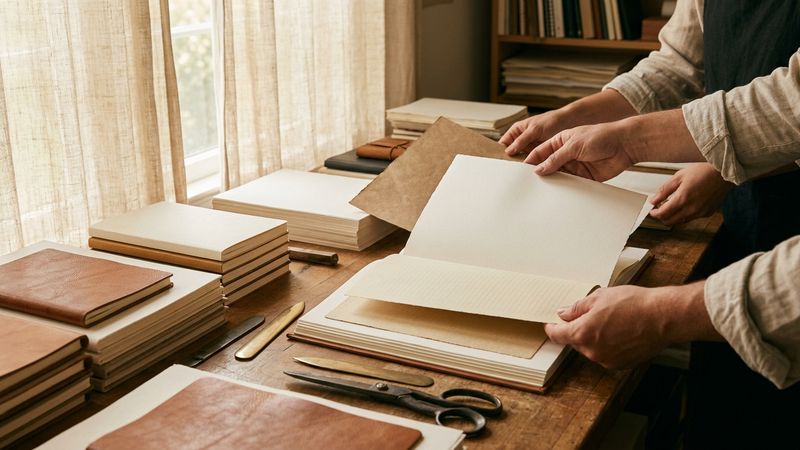
The weight of a sheet of cotton paper tells you something before you read a word printed on it. The texture under your fingertips, the slight resistance as you turn it over, the way light catches the fibres. This is the moment João Costa and Cláudia Baeta built their business around.
In Lisbon's Baixa neighbourhood, O'Momento opened in 2024 as something that doesn't fit neatly into a single category: part retail shop, part co-working space, part active printing house. Costa had spent years running a print studio next door. When the adjacent space became vacant, he and Baeta saw the chance to expand beyond production.
The idea was born from the shared pleasure and joy of working with print, design and paper.
João Costa
The result is a space where customers can buy exquisite craft paper, rare journals, and high-quality pencils, but also learn how to use them and watch them being used by working designers.
The Gap Sofia Hasn't Filled Yet
This model matters for cities like Sofia, where craft culture remains fragmented. Bulgaria has individual artisans working in letterpress, bookbinding, and paper. What it lacks are integrated spaces where a customer can learn, buy, and collaborate under one roof.
Consider Aroma Coffee, where owner Georgi Gagov roasts from green beans and educates customers on origin and technique. The space functions as production facility, retail shop, and classroom simultaneously. But coffee is one vertical. Where are the equivalents for print, paper, and bookbinding?
Curation as Archaeology
One corner of O'Momento holds the ephemeral cabinet, stocked with Portuguese stationery that exists nowhere else. Costa and Baeta sourced it themselves, travelling across the country to find old shops and factories with forgotten inventory.
They were very happy to see us pick up these things that they thought no longer had any value.
João Costa
Bulgaria has its own untapped inventory: defunct printing studios, old bookbinding workshops, warehouses holding materials that someone, somewhere, would pay to use. The challenge is finding them and understanding what they're worth to a contemporary audience.
Education as Core Business
O'Momento's workshops aren't afterthoughts. Recently, Baeta ran a course alongside Pedro Salgado, Portugal's leading scientific illustrator, teaching gyotaku, an 1800s Japanese technique where you apply ink to a fish and press it onto paper.
We brought these enormous fish into the workshop and a group of very brave people tried to master this technique. It produced some spectacular works.
João Costa
The workshops generate revenue, but they also generate community.
Participants become customers. Customers become collaborators.
The best thing in the world is when people ask us what type of paper or binding to use for a certain project.
Cláudia Baeta
Експертизата, вградена в докосването - знанието, което не се побира в каталог.
This is expertise-sharing as product.
Why Physical Media Persists
Baeta's answer to the obvious question is direct:
Print will never disappear because people have a tactile relationship with the objects that they like. Print is irresistible.
Cláudia Baeta
This isn't nostalgia. The digital world hasn't replaced the desire to hold something well-made. If anything, it has intensified it. When everything can be copied infinitely, the thing that cannot be copied becomes more valuable.
O'Momento works because it treats craft as contemporary practice, not heritage preservation. The printing press runs alongside the co-working desks. The workshops teach techniques from the 1800s to people who will post the results on Instagram. There's no contradiction here, only integration.
What a Sofia Version Might Look Like
The structural conditions that made O'Momento possible in Lisbon exist in Sofia, at least partially. There's an audience hungry for craft experiences. There are makers with skills and materials. There's real estate in neighbourhoods like Lozenets or around Zhenski Pazar that could house a hybrid space.
What's missing is the connector: someone willing to combine production, retail, and education into a single sustainable operation. The future of craft retail isn't about selling objects. It's about selling access to materials, knowledge, and community.
The materials exist. The audience exists. The model has been proven. What remains is the decision to build it.
Frequently Asked Questions
Q: What is the O'Momento business model?
A: O'Momento operates as a three-in-one space: retail shop selling craft paper and stationery, co-working space for designers and printers, and active printing house. Revenue comes from product sales, workspace fees, and paid workshops teaching techniques like gyotaku fish printing.
Q: How does O'Momento source its rare stationery?
A: Co-founders João Costa and Cláudia Baeta travel across Portugal to find old shops and factories with forgotten inventory. They purchase materials that previous owners considered valueless and curate them in their ephemeral cabinet for contemporary customers.
Q: What makes hybrid craft spaces sustainable compared to traditional retail?
A: Hybrid spaces generate multiple revenue streams (product sales, workspace rental, workshop fees) while building community that drives repeat visits. Education creates customers; production creates authenticity; retail creates accessibility. The integration reduces dependence on any single income source.
The Slowmade Letter: what happened in the city this week, gathered into one letter.
By subscribing you agree to receive the Slowmade Letter once a week at this address. You can unsubscribe with one click, at any time. How we handle your data
Analytics cookies
We use Google Analytics and Microsoft Clarity to understand which stories get read and how you move around the site. Nothing is recorded without your consent. The cookies needed to sign in always work. Learn more